Learn some particle accelerator basics from a Fermilab accelerator operator.
How do you keep a particle inside of an accelerator? Fermilab accelerator operator Cindy Joe explains.
Video URL
Have a burning question about particle physics? Let us know via email or Twitter (using the hashtag #asksymmetry). We might answer you in a future video!
Now that a Higgs-like boson has been discovered at the Large Hadron Collider, proposals to build colliders that churn out the new particle are gathering momentum.
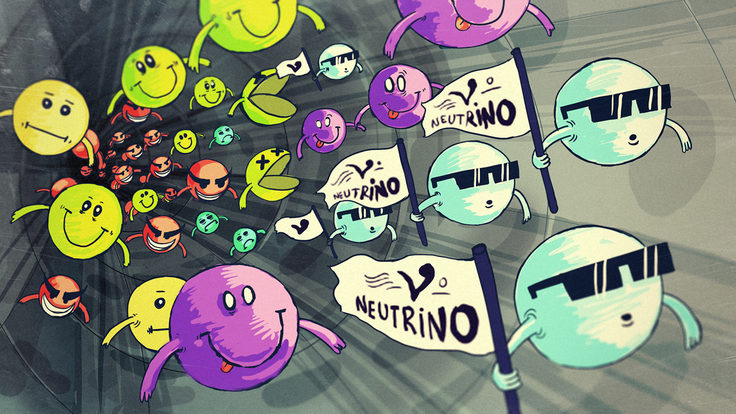
Neutrinos are elusive particles that are difficult to study, yet they may help explain some of the biggest mysteries of our universe. Using accelerators to make neutrino beams, scientists are unveiling the neutrinos’ secrets.
On the hit television show Numb3rs, where crimes are solved with math and science, cosmologist and theoretical physicist Larry Fleinhardt has lived in a monastery and flown into space searching for
When particle accelerators gave birth to the powerful X-ray microscopes known as synchrotrons, they revolutionized the study of virtually every field of science.
When Sal Rappoccio, a postdoctoral researcher from Johns Hopkins University, joined the Compact Muon Solenoid experiment in mid-2007, he did what any newcomer would do.
Seeing is easy. We open our eyes, and there the world is–in starlight or sunlight, still or in motion, as far as the Pleiades or as close as the tips of our noses.