Reviewed by Elizabeth Clements
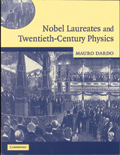
Nobel Laureates and Twentieth-Century Physics
Mauro Dardo
Cambridge University Press, Cambridge, 2004
Do you know why Louis Victor de Broglie won a Nobel Prize in 1929? Or why a Nobel Prize wasn't given out in 1934? What about Nils Gustaf Dalen's invention of an automatic sun valve beating out Max Planck and Albert Einstein for the Nobel Prize in 1912?
In Nobel Laureates and Twentieth-Century Physics, Mauro Dardo, a professor of experimental physics at Amedeo Avogadro University of Eastern Piedmont in Novara, Italy, goes beyond answering these questions and highlights the greatest achievements of 20th century physics. Focusing on the individual stories of each Nobel Prize winner, Dardo uses a unique approach and tells the story of modern physics in a year-by-year format. Starting with Copernicus, the first thirty pages of the book lay out the foundation for modern physics and outline the origins of the Nobel Prize. From relativity to quantum mechanics to superconductivity, Dardo uses simple language to explain the accomplishments of modern physics, and he attempts to decipher some of the more complicated theories of the past century. Written for the lay reader but also of interest to scientists, Nobel Laureates and Twentieth-Century Physics will appeal to history buffs and physics enthusiasts. It's also the perfect text for a history of science course.
Now, as for our opening questions: Louis Victor de Broglie won the Nobel Prize in 1929 for his discovery of the wave nature of electrons. Yet just two years earlier, in 1927, the Nobel Physics Committee had not considered quantum mechanics worthy of a prize because it had not yet led to any experimental discovery of importance.
Even though the 1934 list of Nobel Prize candidates included Max Born and Wolfgang Pauli, the Nobel Prize Committee found no candidate worthy of the prize and decided to reserve it for the following year. The Academy eventually deposited the 1934 prize money in a special fund for Swedish research.
And Nils Gustaf Dalen beat out Max Planck and Albert Einstein for the 1912 Nobel Prize because members of the Academy representing the field of technology felt the awards had become too academic.
Click here to download the pdf version of this article.