Lightweight, abundant and yet notoriously hard to catch, neutrinos are mysterious little particles that have the potential to explain some of the biggest outstanding mysteries about how our universe works.
But one kind of neutrino is persistently tricky to investigate: the tau neutrino.
Neutrinos come in three types: electron, muon and tau. These flavors correspond with the three generations of leptons in the Standard Model of particle physics.
Of all the particles in the Standard Model, “[t]au neutrinos are the least studied,” declares a 2022 white paper published by over 60 particle physicists.
“It’s definitely the hardest neutrino [flavor] to see,” says Doug Cowen, a professor of physics at Pennsylvania State University who works on the IceCube Neutrino Observatory. “And neutrinos are intrinsically difficult to see, so it’s the hardest of the hard.”
The tau neutrino was the last of the three flavors of neutrinos to be hypothesized and discovered. The electron neutrino and muon neutrino were seen in 1956 and 1962. It was the 1975 discovery of the tau lepton by physicist Martin Perl at SLAC National Accelerator Laboratory that alerted the field to the existence of the corresponding tau neutrino.
Even though physicists found plenty of indirect evidence of the tau neutrino’s existence, they would take another quarter century to finally detect it.
Neutrinos rarely interact with matter, so physicists have had to devise creative ways to see them. For example, when a neutrino collides with an atomic nucleus, it produces other particles that physicists can see, so many neutrino detectors look for those neutrino byproducts.
To confirm the existence of the tau neutrino, physicists wanted to see a tau lepton emerge from a neutrino interaction. But tau leptons are very unstable—they decay so quickly that to have a chance of seeing one, physicists had to measure one with very high energy.
Scientists finally achieved that energy with the Tevatron accelerator, which ran for almost three decades at the US Department of Energy’s Fermi National Accelerator Laboratory. On July 21, 2000, scientists on the DONUT collaboration at Fermilab announced the first-ever direct detection of tau neutrino interactions.
While reflecting on 25 years of the tau neutrino, we at Symmetry noticed that all its direct detections thus far have been performed by experiments with remarkably edible names. With that in mind, here is a short guide to celebrating the anniversary of the first detection of the tau neutrino.
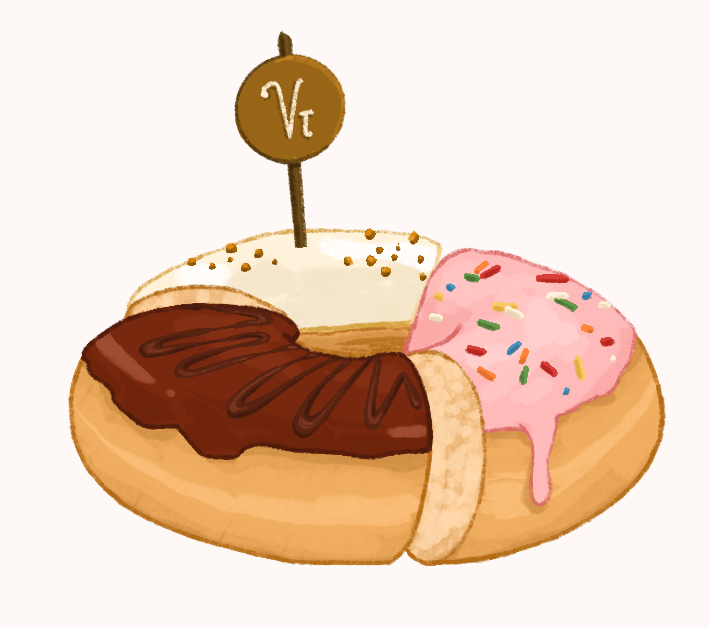
Detection No. 1: DONUT
Background: In the mid-1990s, a dinner-table conversation between Fermilab scientists Byron Lundberg and Gina Rameika inspired the Direct Observation of the Nu Tau, or DONUT, experiment.
The pair were preparing to study neutrino oscillations with a different Fermilab experiment but decided it would probably be a good idea to first make sure tau neutrinos behaved how they expected. “It was pretty well known that we would be able to see this, and we knew there were three neutrinos,” says Rameika, now associate director for high-energy physics at DOE Office of Science. “But the fact is, we never had observed the interaction of a tau neutrino into a tau. It was really motivated by demonstrating the signature of the interaction.”
DONUT’s setup consisted of a three-foot-long structure made of alternating layers of iron and emulsion plates. (Perhaps disappointingly, the DONUT detector was not shaped like a doughnut—but at least the Tevatron was!) The emulsion plate detection technology used had recently been developed by physicists at Nagoya University in Japan.
Physicists used Fermilab’s Tevatron accelerator to shoot protons at a primary target made of tungsten. The resulting neutrinos next reached the DONUT detector, where some of them interacted with iron nuclei to produce even more particles that left visible tracks in the emulsion plates.
Tau neutrinos leave a distinct signature: a short, millimeter-long track with a kink in it, indicating the appearance and quick decay of a tau lepton. Of the 6.6 million neutrinos produced for DONUT, only about 1,000 interacted in the emulsion. Of those, the DONUT collaboration identified just nine instances of the tell-tale checkmark-shaped tracks.
On July 21, 2000, the collaboration announced the first four of these interactions. They had confirmed that the tau neutrino exists and that it behaves as expected.
How to celebrate: To commemorate the 25th anniversary of DONUT’s momentous announcement, snack on a doughnut—or, for extra authenticity, share with friends and neighbors a three-foot-long structure made of alternating layers of doughnuts. If that is for some reason not an option, substitute one or more of the myriad of toroidal foods: bagels, O-shaped cereal, lifesaver mints. Bonus points if they come in three flavors, but you eat only one. If you’re feeling extra excited about the anniversary, consider hosting a hula hoop competition or going inner-tubing with your favorite inflatable torus.
Detection No. 2: OPERA
Background: The Oscillation Project with Emulsion-tRacking Apparatus, also known as OPERA, was the second experiment to see the tau neutrino. Straddling CERN in Switzerland and the Italian National Institute for Nuclear Physics, INFN, and run by an international collaboration of scientists, OPERA was designed to make direct observations of muon- to tau-neutrino oscillation: muon neutrinos turning into tau neutrinos.
In the late 1990s, a giant neutrino detector in Japan called Super-Kamiokande found the first evidence of neutrino oscillation. Scientists observed muon neutrinos disappearing in a way consistent with oscillation to tau neutrinos—but they couldn’t prove definitively that tau neutrinos had taken their places.
“The missing tile in this puzzle was to find the appearance of a tau neutrino in a muon neutrino beam,” proof that the neutrino was oscillating from one flavor to the other, says Giovanni De Lellis of INFN Napoli and CERN, and former spokesperson of OPERA.
From 2008 to 2012, scientists sent a beam of neutrinos from CERN to INFN’s Gran Sasso Laboratory 730 kilometers away. The detectors at Gran Sasso used the same emulsion technology originally developed for DONUT.
Ultimately, OPERA found 10 candidate tau-neutrino events with a very high level of significance, demonstrating unambiguously that muon neutrinos oscillate to tau neutrinos as they travel.
This direct observation provided the conclusive proof needed to confirm neutrino oscillations. It validated Super-K’s observations—and even cemented the scientific foundation for the 2015 Nobel Prize in Physics.
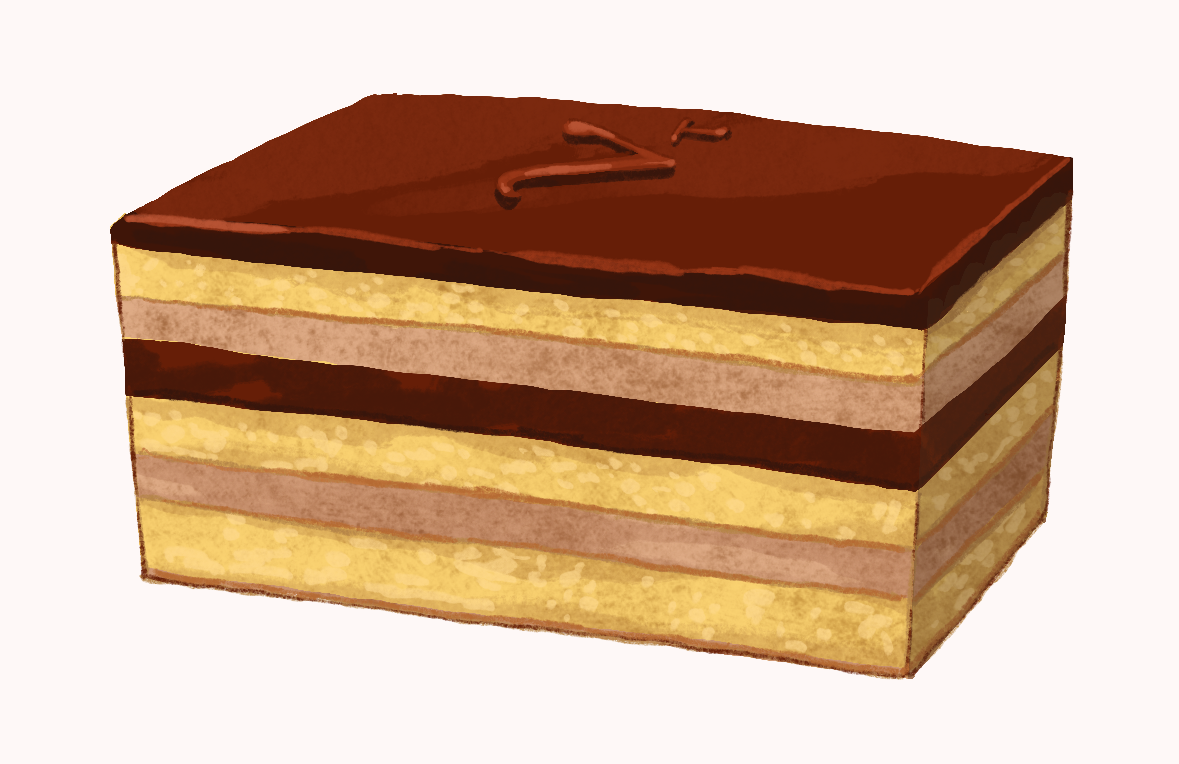
How to celebrate: Consider treating yourself to an opera cake, a French confection made of layers of almond sponge cake, ganache, and coffee buttercream. You can even make one yourself! To enhance the experience, listen to music while you bake, perhaps an aria from “Don Giovannu,” “Tausca” or “Carmuon.”

Detection No. 3: IceCube
Background: The most recent detection of tau neutrinos came from the IceCube Neutrino Observatory, an array of over 5,000 optical detectors buried a mile deep in the South Pole ice. In 2024, the IceCube Collaboration announced seven candidate tau neutrinos found in data from the previous decade.
IceCube looks for neutrinos from the atmosphere and from cosmic sources with much higher energies than neutrinos observed by DONUT and OPERA. When neutrinos hit nuclei in the ice, the resulting charged particles move so fast that they generate a cone of blue light called Cherenkov radiation. This light triggers the in-ice optical modules, so IceCube can identify neutrinos by examining the patterns of lit-up detectors.
Of the three flavors, IceCube is most sensitive to muon neutrinos since muons travel far in the detector, leaving a long trail of activated modules. Tau leptons, by contrast, travel very short distances before decaying. In IceCube, a tau neutrino signal is identifiable by two spherical patterns close together: where a tau was created and then where it quickly decayed.
Cowen, a lead on the tau neutrino analysis, says IceCube actually sees tau neutrinos all the time in atmospheric neutrino oscillations. But the 2024 paper represented their first results with an “exclusive” sample—a sample in which they identified individual astrophysical tau neutrinos, rather than a population of neutrinos that probably included tau neutrinos.
“We breathed a sigh of relief when we saw roughly what we expected,” says Cowen.
Since that study, the IceCube collaboration has uncovered more tau neutrino candidates in its multi-flavor analyses, which were described at a conference this month. IceCube’s latest count is 15 tau neutrinos.
But with new experiments capable of detecting tau neutrinos on the horizon, Cowen says, “IceCube can only enjoy its perch up at the top of this rather small mountain of tau neutrinos for a short time.”
How to celebrate: In honor of IceCube’s cosmic contribution to the study of tau neutrinos, have some iced coffee or iced tea, or add ice cubes to your beverage of choice. While not strictly cube-shaped, ice cream can also be consumed in celebration of the IceCube tau neutrinos, especially if eaten under the stars. (Bonus: If you have ice cream one day early on July 20, you will also be celebrating National Ice Cream Day in the United States!) (Bonus to the bonus: If you have three flavors of ice cream, you will be doubly—triply?—celebrating neutrinos, since neutrino oscillation is sometimes compared to Neapolitan ice cream.)
The next 25 years
Many current and future experiments are either specifically looking for or are capable of seeing tau neutrinos. At CERN, experiments like SHiP could detect tau neutrinos at energies similar to DONUT and OPERA, while FASERν and SND@LHC will see neutrinos at energies up to a thousand times higher.
To search for more high-energy tau neutrinos, IceCube has proposed a major expansion to their South Pole detector array called IceCube-Gen2. Similar water-based arrays, like P-ONE and KM3Net, may be even better at seeing the short-lived tau leptons than ice-based arrays. Scientists have proposed more than one tau-neutrino telescope to probe ultra-high-energy ranges for tau neutrinos. Physicists hope to one day detect the tau neutrino’s antimatter cousin, the tau antineutrino.
“There’s still a lot to do in this field, and we are actually really excited to continue investigating tau neutrinos,” says De Lellis, who is currently spokesperson for SND@LHC.
No matter how you choose to celebrate, remember that 100 billion neutrinos of all flavors pass through your body every second. Whether you’re eating a giant structure made of doughnuts, attempting to sing along to an opera in your kitchen, or carving Neapolitan ice cream into a cube under the night sky, tau neutrinos are with you all the time.