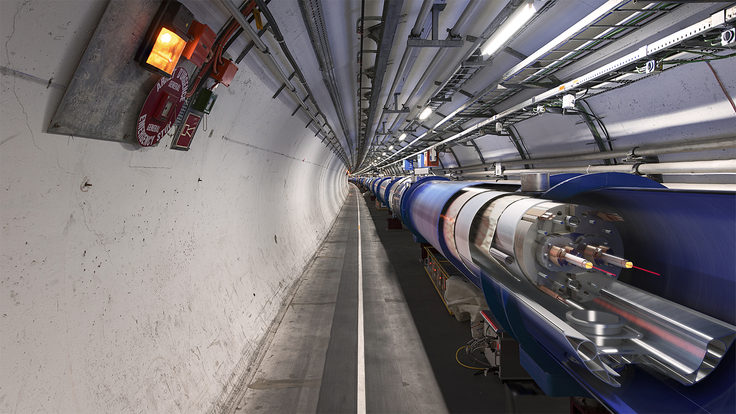
Learn some particle accelerator basics from a Fermilab accelerator operator.
How do you keep a particle inside of an accelerator? Fermilab accelerator operator Cindy Joe explains.
Video URL
Have a burning question about particle physics? Let us know via email or Twitter (using the hashtag #asksymmetry). We might answer you in a future video!
The Collider Detector at Fermilab (CDF) is one of two experiments that record the debris of powerful proton-antiproton collisions at the Tevatron particle collider to explore subatomic processes.
On October 19, 1991, at 6:50 p.m., Bjørn Wiik logged the first collisions in the new electron-proton particle collider at the Deutsches Elektronen-Synchrotron in Hamburg.
Men and women wearing gaudy dresses, looking for customers under garish neon signs—this is a common sight in Kabuki-cho, Shinjuku, a famous entertainment and red-light district in Tokyo, Japan.
In August, the International Linear Collider reached an important milestone when two huge documents were presented to the international particle physics community at a meeting in Daegu, Korea.
Fermi National Accelerator Laboratory in Batavia, Illinois has a challenge: how will it maintain its central role as a place where particle accelerators produce groundbreaking discoveries in physic