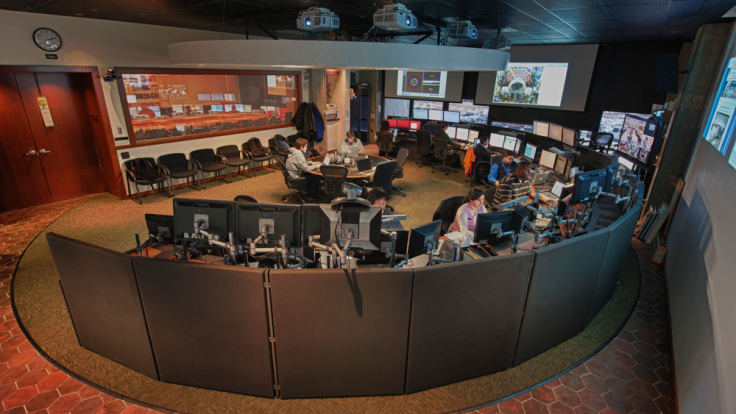
Learn some particle accelerator basics from a Fermilab accelerator operator.
How do you keep a particle inside of an accelerator? Fermilab accelerator operator Cindy Joe explains.
Video URL
Have a burning question about particle physics? Let us know via email or Twitter (using the hashtag #asksymmetry). We might answer you in a future video!
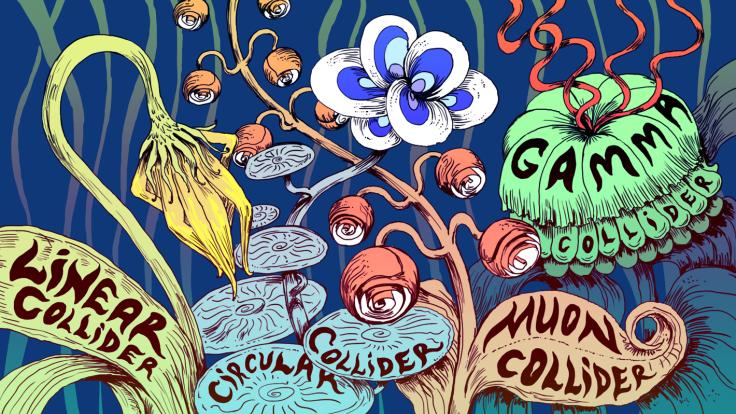
Now that a Higgs-like boson has been discovered at the Large Hadron Collider, proposals to build colliders that churn out the new particle are gathering momentum.
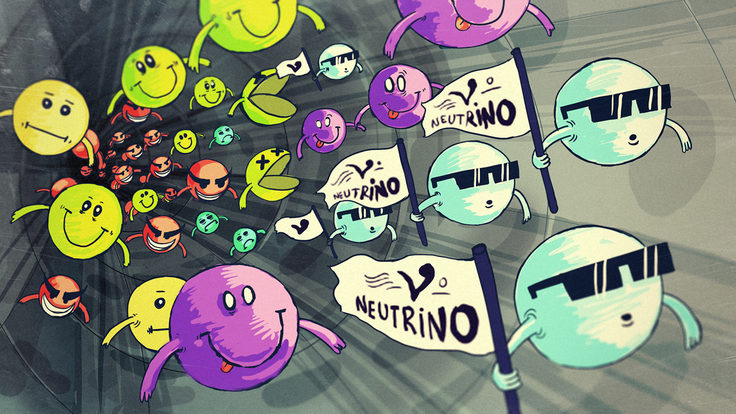
Neutrinos are elusive particles that are difficult to study, yet they may help explain some of the biggest mysteries of our universe. Using accelerators to make neutrino beams, scientists are unveiling the neutrinos’ secrets.
As Clark Cully watched the movie Déjà Vu with his parents, something about the movie’s time machine—with its bright blue wedges of metal spewing a ring of wires—seemed eerily familiar.
The modern age of science was born in a system of patronage and independently wealthy hobbyists pursuing questions that would satisfy their curiosity or fill their pocketbooks.
On October 19, 1991, at 6:50 p.m., Bjørn Wiik logged the first collisions in the new electron-proton particle collider at the Deutsches Elektronen-Synchrotron in Hamburg.
Men and women wearing gaudy dresses, looking for customers under garish neon signs—this is a common sight in Kabuki-cho, Shinjuku, a famous entertainment and red-light district in Tokyo, Japan.
In August, the International Linear Collider reached an important milestone when two huge documents were presented to the international particle physics community at a meeting in Daegu, Korea.
Fermi National Accelerator Laboratory in Batavia, Illinois has a challenge: how will it maintain its central role as a place where particle accelerators produce groundbreaking discoveries in physic