Add filters
Type
Category
03/01/12

Ten things you may not know about the Higgs boson

This year, results from the Large Hadron Collider in Europe and the Tevatron in the United States will either prove or refute the existence of the Standard Model Higgs particle, a keystone in theorists’ proposed explanation for the origin of mass.

03/01/12

Reliability of accelerator driven systems

I was the chairman of the committee that recommended to the DOE that the Accelerator Driven Systems (ADS) approach to dealing with the long-lived component of spent nuclear fuel be terminated.

03/01/12

A new era for symmetry

Welcome to the first issue of a new symmetry. Starting this month, symmetry goes back to its monthly roots with a modern twist: The magazine will come out once a month online, supplemented with breaking news from our symmetry breaking blog.

03/01/12

Don't forget RHIC / 60 billionths

Readers rightly pointed out that the Relativistic Heavy-Ion Collider at Brookhaven National Laboratory is operating well and colliding a range of particles from protons to gold nuclei, with funding from the Department of Energy's Office of Nuclear Physics. We also can't count.

03/01/12

Moose and the Higgs boson

I just read your editorial "Moose and the Higgs boson" (February 2012). The first paragraph is the nerdiest thing I have ever read.

03/01/12

The brain behind TV's The Big Bang Theory

For those who live, breathe and laugh physics, one show entangles them all: The Big Bang Theory. To make the show's jokes timely and accurate, while sprinkling the sets with authentic scientific plots and posters, the show's writers depend on one physicist, David Saltzberg.

03/01/12

The cosmic-ray riddle

Data from the world’s most powerful particle colliders should shed light on a 100-year-old astrophysics mystery, but even they cannot explain the perplexing properties of the universe’s most energetic particles. Are ultra-high-energy cosmic rays heavier than expected?

03/01/12

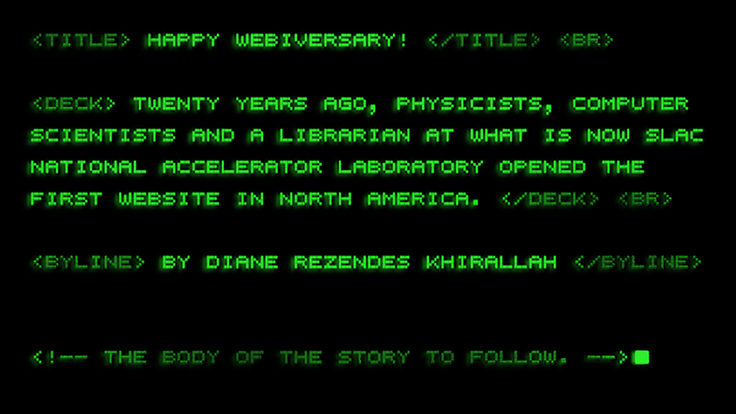
Happy Webiversary

In 1991, physicists, computer scientists, and a librarian at what is now SLAC National Accelerator Laboratory opened the first website in North America.