Because particle physicists cannot directly see the objects they study, they rely on deduction and decay products to detect nature's tiny, ephemeral particles.
I have heard conflicting reports as to who decided to call one of the most spectacular intellectual innovations of human history "the Standard Model," physicists' best construct for explaining the range and behavior of elementary particles that make up the universe as we know it.
Physicists and scientists of other disciplines around the world have created countless research sites that remind me of the colossal dimensions of ancient temples, in one way; and, in another, of fragile, beautiful little altars where they orchestrate experiments, with research objects largely in
Custom designed microchips have become essential in processing signals from modern physics experiments that generate lots of data. This chip, the QIE9, designed by Fermilab engineers, is just one example of the many Application Specific Integrated Circuits (ASICs) used in such experiments.
The National Academy of Sciences has charged a group of scientists, the "Elementary Particle Physics in the 21st Century" (EPP2010) committee, with "prioritizing the scientific questions and opportunities that define elementary-particle physics." Importantly, half the committe
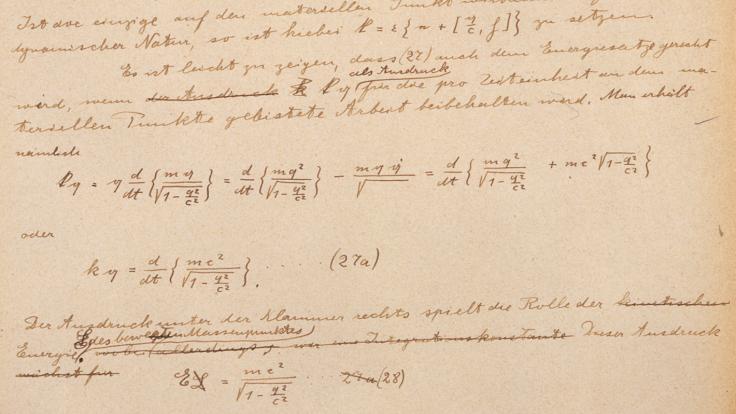
Einstein had promised but later refused to publish this 1912 expository treatise, his earliest known manuscript on special relativity. No original manuscripts survive for the articles of Einsteins 1905 annus mirabilis.
Prior to the development of special relativity, the laws of physics and the laws of common sense were practically one and the same. Measurements of space and time were absolute. There were no limits in principle on how fast a person could travel.
Radiotherapy Grid computing offers an application of high-energy physics research-work- still-in-progress with tangible and immediate clinical utility to the one million Americans who will be treated with radiotherapy next year.
Out here in rural Stearns County, Minnesota, I have taken to leaving my copy of symmetry on the coffee table. Then when people ask, “Say, what is this all about?” I casually reply, “Oh, that's a little magazine that Fermilab and SLAC send me every month. Would you like to read it?”
Inspired by the pixel structure of far away objects in astronomical images, artist Tim Otto Roth uses live scientific data to create visions of science in action.
The growing relationship of astrophysics and particle physics is a hot topic these days. In addition to the appearance of new faces and institutions at the labs, the growth of this area of research can actually be seen in the references of particle physics papers.