In August 2005 nearly seven hundred physicists and engineers from around the world traveled to the small Rocky Mountain town of Snowmass, Colorado, to advance the planning and design of the proposed International Linear Collider.
Few facets of nature are more mysterious than the quantum world. Particles that appear and disappear from nothing, interactions governed by probability, and intrinsic uncertainties are enough to baffle even the most experienced scientist.
Could a romance heroine cut it as an astrophysicist? That was the question I had to answer two years ago when I started working on my romance novel, It Should Happen To You.
Public participation is a critical issue for planners of the proposed International Linear Collider. The recent Snowmass conference included a daylong session titled, "Workshop on Public Participation in the ILC," sponsored by the US Linear Collider Communication Committee.
After darkness sets in each night, a wall of TV monitors in the control room of Apache Point Observatory continually displays the telescope's view of the heavens.
Like climbers assessing a new route before making the ascent, physicists have been looking for footholds on a vertiginous new terrain. These footholds contain important information for trekking to TeV heights (the lofty trillion electron volts energy scales of future colliders).
Nearly 700 physicists from around the world met in Snowmass, Colorado, to advance plans to create an International Linear Collider, a next generation machine that would answer the most fundamental questions about the universe.
This year, the SLAC Summer Institute, a two-week-long series of physics lectures for young scientists, focused on gravity and Einstein's theories of relativity.
I have spent the past year at the Department of Energy in Washington, DC, as Scientific Advisor to Robin Staffin, the Associate Director for High Energy Physics.
The universe is weird. With only 5 percent of the universe in our sight, potential new families of particles, possible extra dimensions, and mass created by an all-pervasive, invisible field, our understanding almost looks feeble.
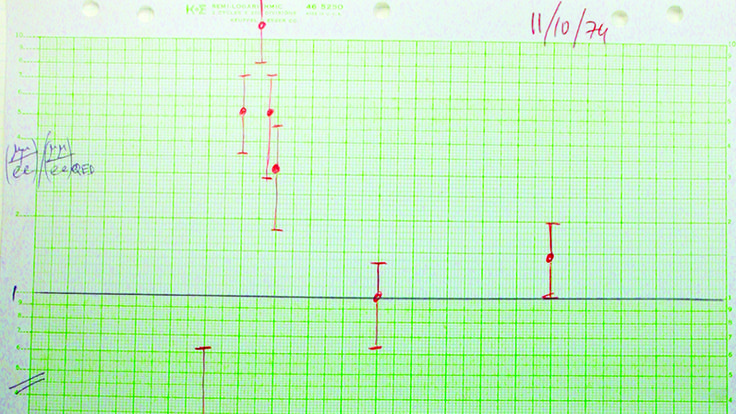
Burton Richter’s group double-checked what they thought was a minor statistical inconsistency in their data. Using the Stanford Positron Electron Accelerating Ring (SPEAR), they probed electron-positron collision energies around 3.1 GeV.
I am lecturer in physics in a remote area of Pakistan where Internet facilities are hardly found. Fortunately, once I was browsing the Web to find out physics material when I came across your site.
I am a science student from Nigeria and would like to commend Fermilab/SLAC for relentless effort in keeping thousands around the world acquainted with the latest developments in the world of particle physics.
On page 18 of the June/July issue in the story “No Little Plans”, you state “With California’s SLAC, Japan’s KEK and Germany’s DESY laboratories making the transition from particle physics to light-source-based research…”
Almost in time with the rhythmic open-mouthed chewing and the occasional call for more ketchup during lunchtime at Fermilab's day care center comes the repeated mantra, "Careful of your milk."