Over the next few years, the United States and the international high-energy physics communities will see great scientific opportunities and profound changes. These, in turn, will pose profound challenges.
Science is a forward-thinking endeavor: It is more concerned with what can be discovered in the future than what has been learned in the past. Once accomplished, successes are usually taken for granted.
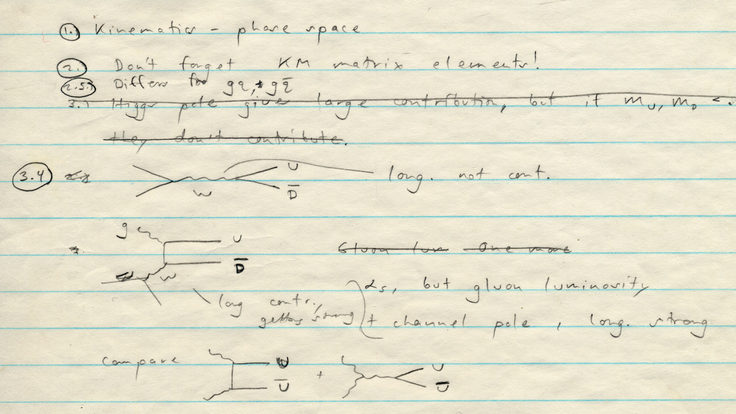
In 1985, ten years before scientists at Fermilab discovered the top quark, Scott Willenbrock was a graduate student at the University of Texas at Austin.
During the majority of my 57 years of existence, I’ve waited with the anticipation of a child on Christmas Eve for the truly exciting discoveries that have been and continue to be made.
The world, by some accounts, was created in seven days. Not to try and top that, but a university band managed to re-enact the big bang in a period of less than an hour.
A one-time visitor to SLAC, the Antarctic Impulsive Transient Antenna (ANITA), recently took to the frigid skies over Antarctica on a mission looking for evidence of cosmic-ray neutrinos.
I have been attending hundreds of talks by particle physicists who look for a very specific experimental signature that is predicted by a very specific theory extending the Standard Model.
How do you renovate a delicate, irreplaceable detector? Very carefully. During the last four months of 2006, the BaBar collaboration at SLAC successfully replaced a prematurely aging muon identification system.
Like many Americans, my taste for the sciences was soured at a young age. I recall lugging around heavy, impersonal textbooks full of confusing diagrams and bizarre word problems.
The Compact Muon Solenoid (CMS) detector is one of the two general purpose particle detectors being constructed at CERNs Large Hadron Collider (LHC) outside Geneva, Switzerland.
Guest houses are common among particle physics labs, and the Stanford Linear Accelerator Center is no exception. But in many ways, the Stanford Guest House, situated on the grounds of SLAC, is different.
As physicists and engineers devise ways to make the International Linear Collider perform better at a lower cost, the design evolves, sometimes with tweaks but at other times with major reconfigurations.