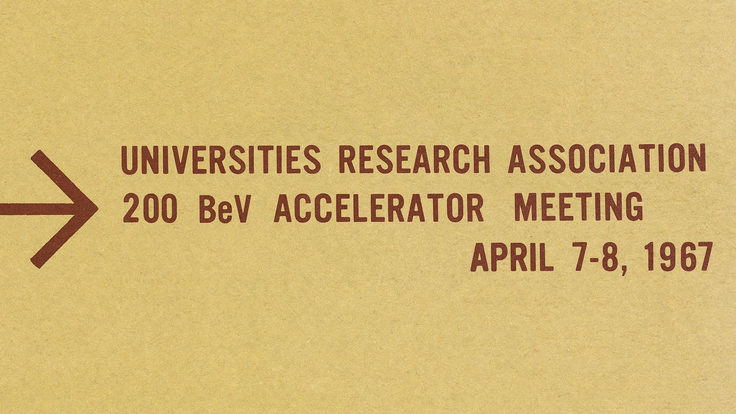
In 1967, 400 enthusiastic scientists met at Argonne National Laboratory to discuss plans to build a new 200 GeV accelerator and a national laboratory to house it.
Before conversion to a superconducting magnet, the Fermi Chicago Cyclotron Magnet (symmetry, Dec 2006) was used in the Neutrino Area as an analyzing magnet for muons.
Congratulations to 12-year-old Austin Ellsworth on his fun model of a linear accelerator (symmetry, Mar 2007). However, using antimatter for fueling spaceships or energy storage, as in Dan Brown's book Angels and Demons, will never happen.
Bird watchers have life lists of sightings. We think fans of particle physics need a checklist of their own, full of not-to-be missed places, experiences, and artifacts.
Regarding “Masters of improv” (symmetry, April 2007) I have one question. The article quotes former Fermilab director Leon Lederman as saying, “ without explanation, we took the student's experiment apart. He started crying, as he should have.” Was the student compensated for his loss?
In the April 2007 edition a letter was printed debunking the idea of antimatter-powered spaceships. The argument was that since antimatter is so difficult and expensive to produce, this use is impractical.
Sudoku is so 2005, but this logic puzzle still has plenty of fans. Invented in 1979 by an American, the puzzle really took off in Japan. In the years since, it has distracted aficionados daily, appearing in the pages of newspapers worldwide alongside the traditional crossword puzzle.
The problem: How to get short-lived radioactive drugs from the nuclear physics lab that makes them to a hospital 2.5 kilometers away, on the far side of a busy campus, in two minutes flat.
When objects weighing thousands of pounds have to be moved, the call goes out to riggers— specialized teams that work with hoists and cranes. They’re required to wear proper safety gear; and at some point, the riggers at SLAC decided to make a statement with their helmets.
Peter Fisher was in the audience when Marin Soljacic, a fellow physicist at the Massachusetts Institute of Technology, gave a lunchtime talk about a technology that could transform consumer electronics.
An overgrown zebra mussel population at Fermilab received a rude awaking when operations engineers treated the lab’s water cooling system in early June to remove nearly 4000 pounds of mussels.
People visit Fermilab for many reasons. For those with an interest in physics or engineering, the draw, of course, is the chance to see Fermilab’s equipment up close and the opportunity to sample life at a great laboratory.
Chalkboard discussions usually arise spontaneously, with one person explaining something to a small group standing nearby. Scratchings on the board tend to represent fragments of a conversation rather than a complete train of thought.