As Clark Cully watched the movie Déjà Vu with his parents, something about the movie’s time machine—with its bright blue wedges of metal spewing a ring of wires—seemed eerily familiar.
It was 80 degrees under a cloudless sky in St. Charles, Illinois. Thunder boomed. Lightning flashed, striking a kite and shooting down the string to a bald scarecrow. Its giant eyes glowed. “What’s that?” asked a Girl Scout working on a nearby display.
Monica Dunford couldn’t stop swaying when she finally got out of the boat after 15 hours, 33 minutes, and 15 seconds of hard rowing. The physicist and her four teammates had just won the Tour du Leman, held Sept. 22.
Our tour guide encouraged us to look at our destination, the NuMI tunnel, some 300 feet below. Standing next to the rail, one hand holding my hard hat in place and the other keeping my glasses from flying off, I looked down into what seemed to be a bottomless pit.
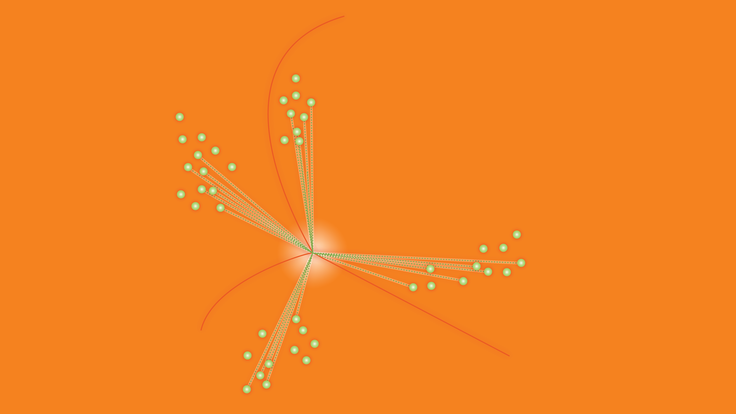
The Collider Detector at Fermilab (CDF) is one of two experiments that record the debris of powerful proton-antiproton collisions at the Tevatron particle collider to explore subatomic processes.
In March 2007, members of a US National Science Foundation panel went on a whirlwind bus tour of potential sites for the Deep Underground Science and Engineering Laboratory. Here's an account of that trip by Peter Fisher of the Massachusetts Institute of Technology.
Physicist Brian Cox has been watching science fiction movies since he was a small child. He always scoffed at the imprecise nature of the science in movies. But over the past year, he learned a lot about the balance between making a movie entertaining and making it scientifically correct.
The next big experiment in particle physics won’t need an accelerator, detector, or other big machine. It doesn’t even involve subatomic particles—unless you count the electrons that flow through electronic circuits, carrying bits of information from one human brain to the next.
Science is an international activity. It is elementary that communication and collaboration among scientists promote scientific progress. No group has a monopoly on good ideas.
The modern age of science was born in a system of patronage and independently wealthy hobbyists pursuing questions that would satisfy their curiosity or fill their pocketbooks.
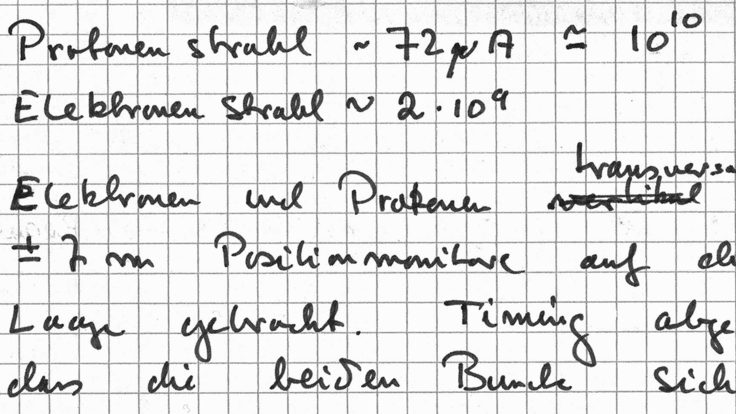
On October 19, 1991, at 6:50 p.m., Bjørn Wiik logged the first collisions in the new electron-proton particle collider at the Deutsches Elektronen-Synchrotron in Hamburg.
We asked you to use Roz Chast’s cover of the May issue of symmetry as inspiration to go beyond the elementary particles already discovered or theorized and tell us about the particles of your dreams. The dozens of responses were clever, funny, and insightful.
Men and women wearing gaudy dresses, looking for customers under garish neon signs—this is a common sight in Kabuki-cho, Shinjuku, a famous entertainment and red-light district in Tokyo, Japan.
Search for “BaBar” on YouTube.com, and you'll get a long list of links to a 1980s TV series based on an animated elephant. But a surprise is hidden among the cartoons—a six-minute film shot in the Stanford Linear Accelerator Center's BaBar control room.