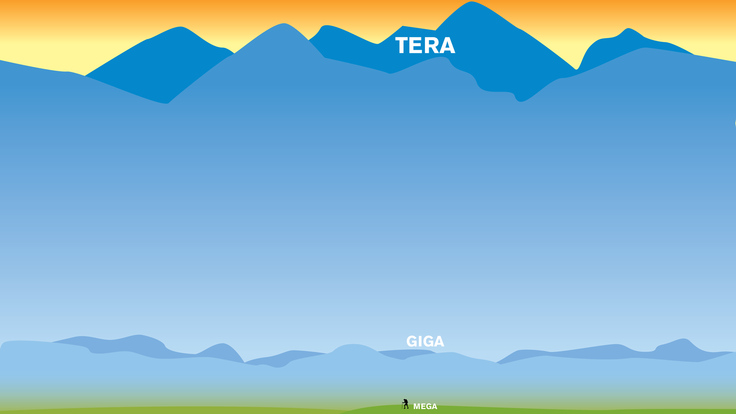
The Terascale is an energy region named for the tera, or million million, electronvolts of energy needed to access it. Physicists are standing at its threshold, poised to enter this uncharted territory of the subatomic world.
With so much work to do on so many aspects of the Large Hadron Collider—the accelerator, detectors, software, physics, and so on—it’s hard not to get a bit lost.
Among the 10,000 people from around the world who are working on the Large Hadron Collider, 1000 hail from universities and national labs in the United States.
Every time I take visitors to see the Large Hadron Collider, I’m reminded of the extent of the international collaboration that has made this project possible.
We are on the eve of one of the greatest experiments in the history of physics. The Large Hadron Collider, a 27-kilometer ring straddling the Swiss-French border, is pushing the frontier of exploration into the fundamentals of our universe.
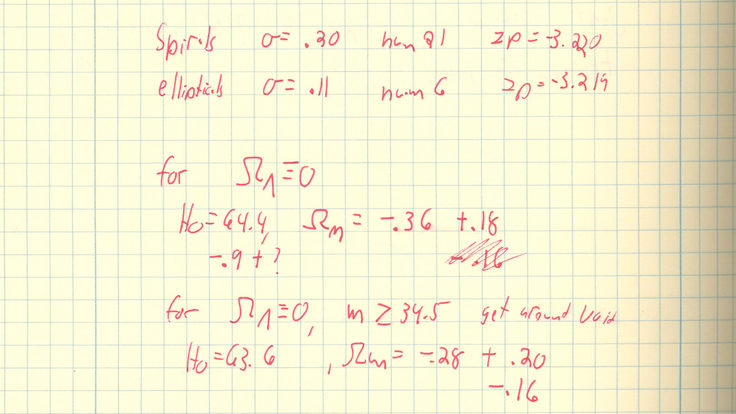
In the fall of 1997, I was leading the calibration and analysis of data gathered by the High-z Supernova Search Team, one of two teams of scientists the other was the Supernova Cosmology Projecttrying to determine the fate of our universe: Will it expand forever, or will it halt and contract, r
While looking through the Aug 07 issue of symmetry, I enjoyed reading Glennda Chui’s article “The particle physics life list.” There’s a picture of “Hans Bethe and friend” touring what is now the CESR tunnel at Cornell University’s Laboratory for Elementary-Particle Physics.
Since I visited Fermilab almost seven years ago on a cross-country trip, I’ve enjoyed keeping in virtual touch with the world of high-energy physics, first through FermiNews and now through symmetry.
Some of these paintings by Roshan Houshmand (symmetry, Jun/Jul 07) remind me of the works of Paul Klee (of the Bauhaus School in the 1920s in Germany) and also those of Joan Miró to some extent in another way. Certainly her painting “Retro” connects in my mind with Kandinsky.
JoAnne Hewett’s most recent paper is a collaboration between physicists at the Stanford Linear Accelerator Center, the University of Chicago, and the Massachusetts Institute of Technology.