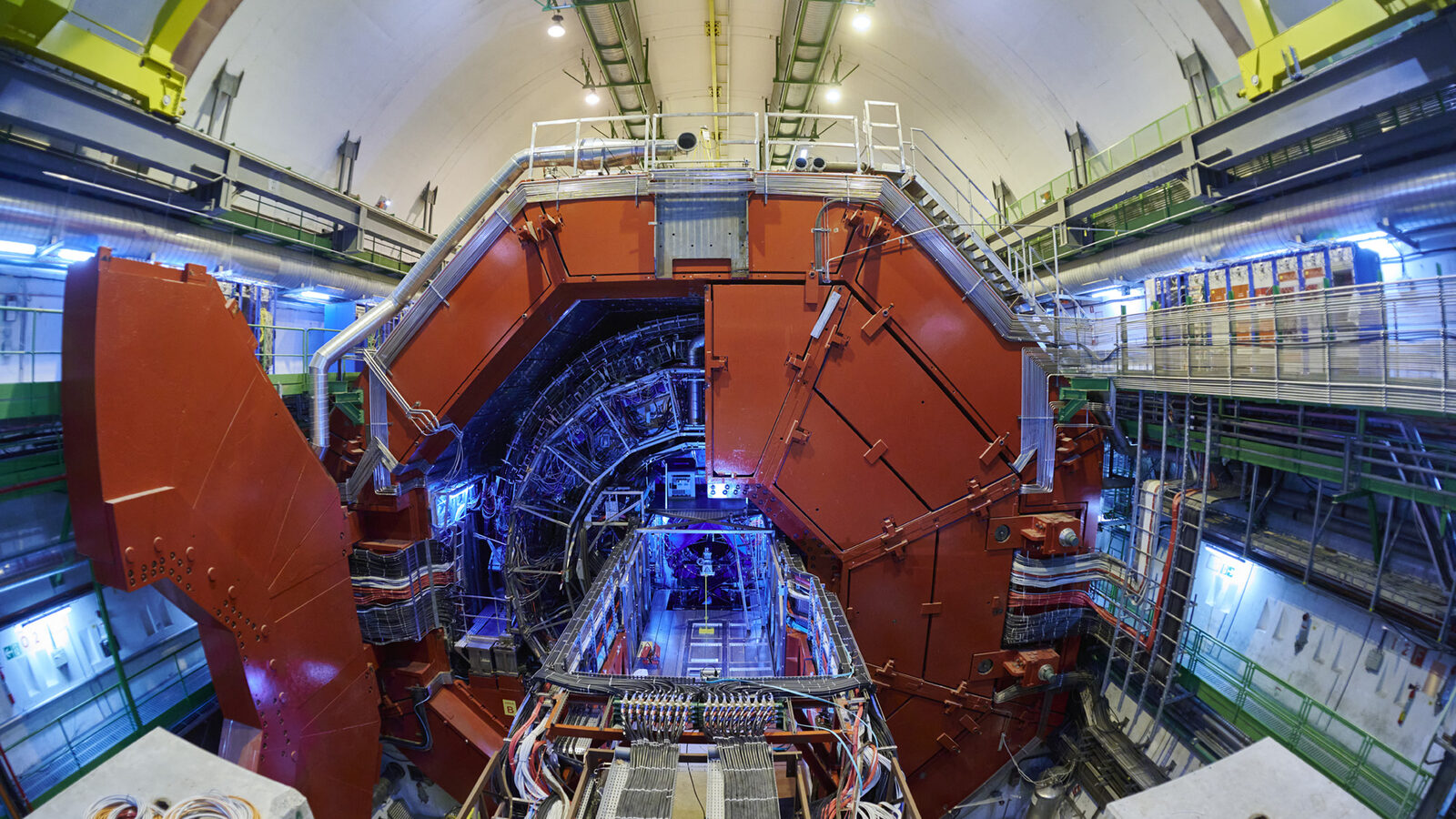
In 2023, the ALICE experiment was ready for their best year yet, until a mysterious signal threatened everything. As the LHC wraps up its 2025 lead-ion run, physicists recall how they worked together to solve the puzzle.
In less than three years, scientists will start up the world's largest scientific instrument: The Large Hadron Collider. US scientists have built key components for the machine and its experiments, paving the way for their participation in a decade of discoveries.
In honor of the World Year of Physics, symmetry featured an Albert Einstein teddy bear on the cover of the February issue. Since then, we have received a steady stream of phone calls and email.
The CMS (Compact Muon Solenoid) detector at CERN, in Geneva, Switzerland, and the new CMS offices at Fermilab are separated only by the amount of time it takes light to travel between the two places.
Custom designed microchips have become essential in processing signals from modern physics experiments that generate lots of data. This chip, the QIE9, designed by Fermilab engineers, is just one example of the many Application Specific Integrated Circuits (ASICs) used in such experiments.
Physicists and scientists of other disciplines around the world have created countless research sites that remind me of the colossal dimensions of ancient temples, in one way; and, in another, of fragile, beautiful little altars where they orchestrate experiments, with research objects largely in