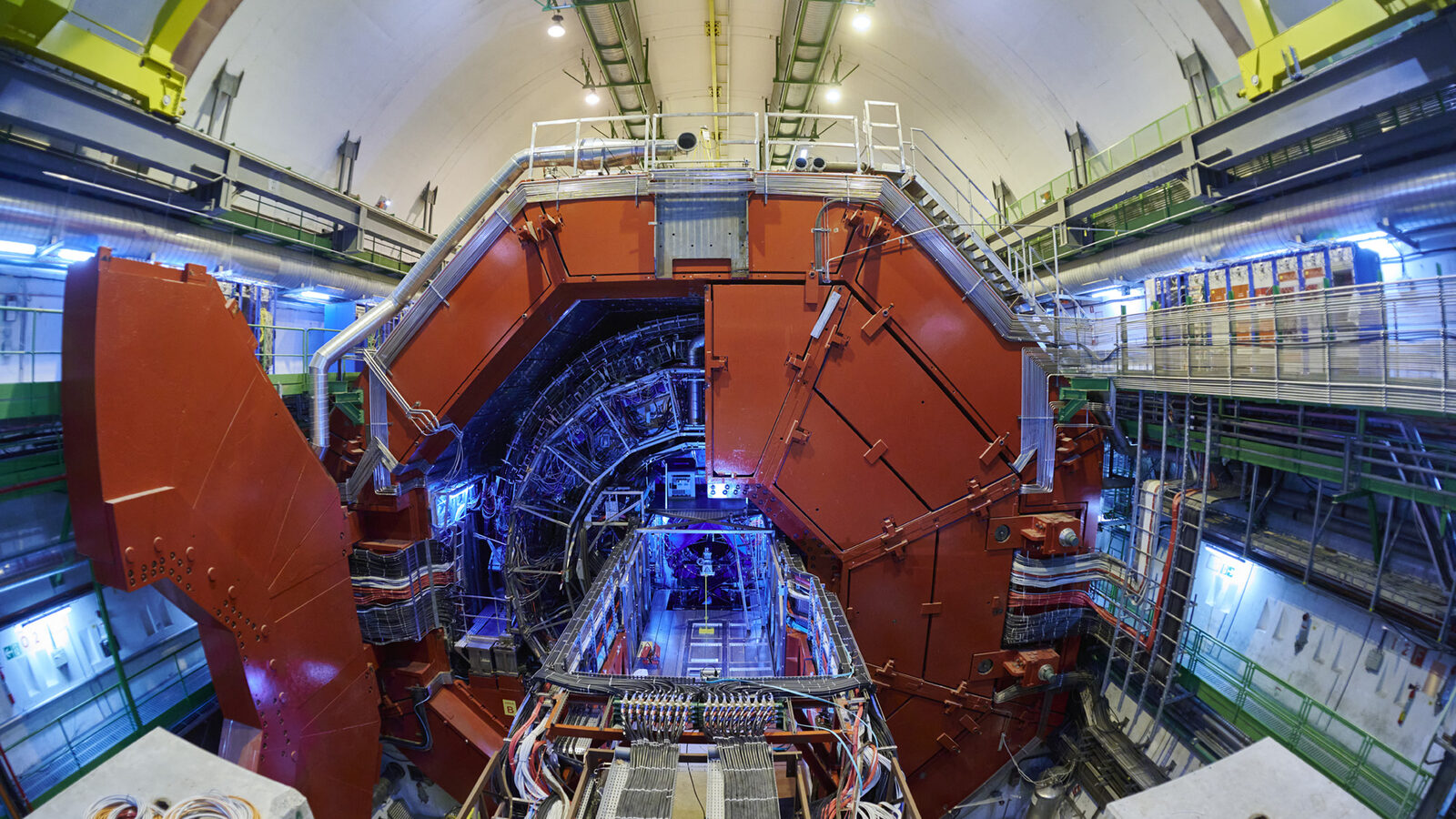
In 2023, the ALICE experiment was ready for their best year yet, until a mysterious signal threatened everything. As the LHC wraps up its 2025 lead-ion run, physicists recall how they worked together to solve the puzzle.
In January 2000, Tom Jordan had just finished up a conference in San Diego, where he had presented one of the new cosmic ray detectors to QuarkNet teachers.
The Large Hadron Collider is currently being installed in a 27-kilometer ring buried deep below the countryside on the outskirts of Geneva, Switzerland. When its operation begins in 2007, the LHC will be the worlds most powerful particle accelerator.
Custom designed microchips have become essential in processing signals from modern physics experiments that generate lots of data. This chip, the QIE9, designed by Fermilab engineers, is just one example of the many Application Specific Integrated Circuits (ASICs) used in such experiments.
Because particle physicists cannot directly see the objects they study, they rely on deduction and decay products to detect nature's tiny, ephemeral particles.