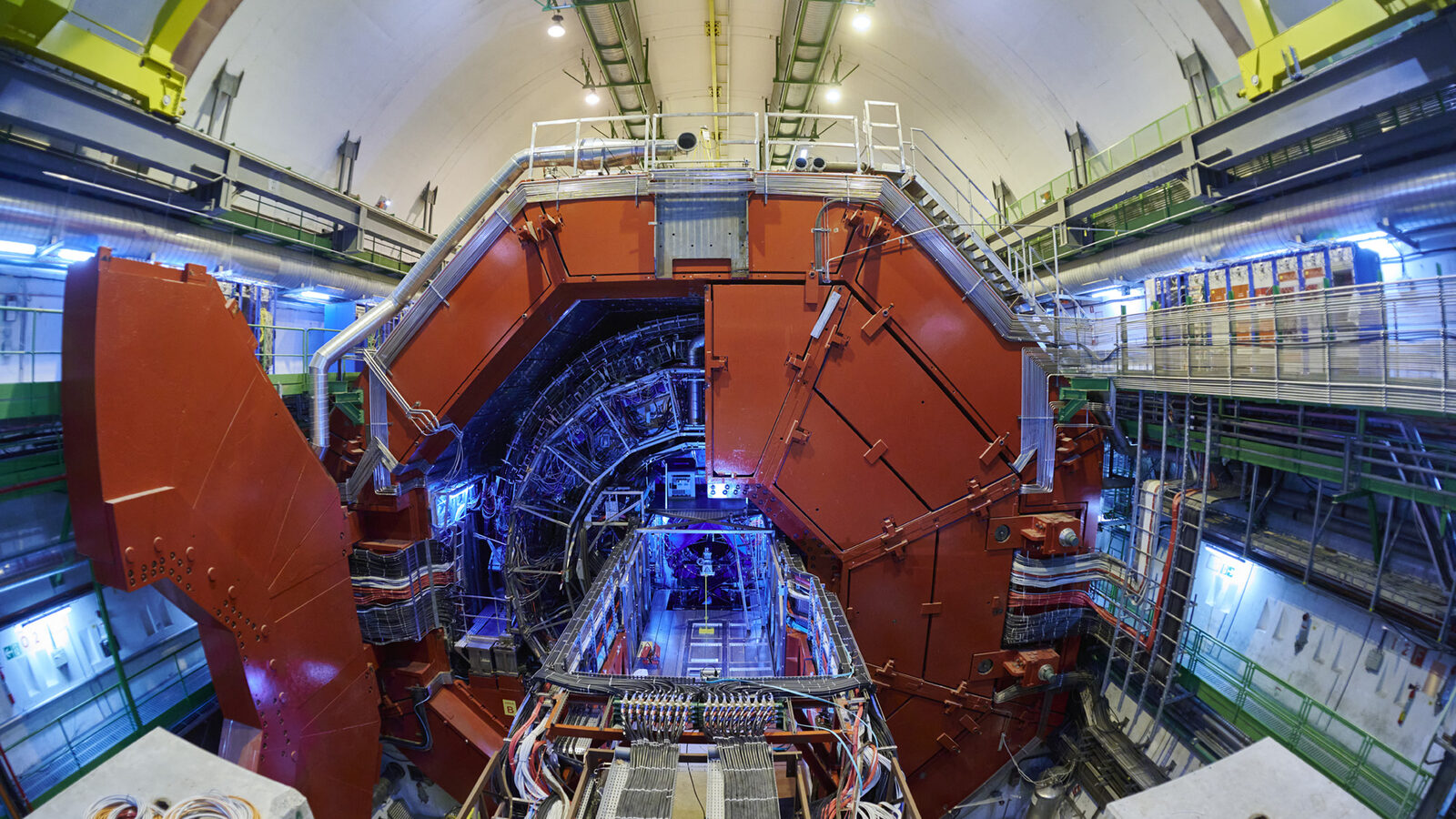
In 2023, the ALICE experiment was ready for their best year yet, until a mysterious signal threatened everything. As the LHC wraps up its 2025 lead-ion run, physicists recall how they worked together to solve the puzzle.
In less than three years, scientists will start up the world's largest scientific instrument: The Large Hadron Collider. US scientists have built key components for the machine and its experiments, paving the way for their participation in a decade of discoveries.
The Large Hadron Collider is currently being installed in a 27-kilometer ring buried deep below the countryside on the outskirts of Geneva, Switzerland. When its operation begins in 2007, the LHC will be the worlds most powerful particle accelerator.
Custom designed microchips have become essential in processing signals from modern physics experiments that generate lots of data. This chip, the QIE9, designed by Fermilab engineers, is just one example of the many Application Specific Integrated Circuits (ASICs) used in such experiments.
Working at Stanford Linear Accelerator Center, you never know what projects may come your way. So when Helen Quinn, head of education outreach at SLAC, asked me to plant trees with a class of fourth graders, I said sure, it's not rocket science.