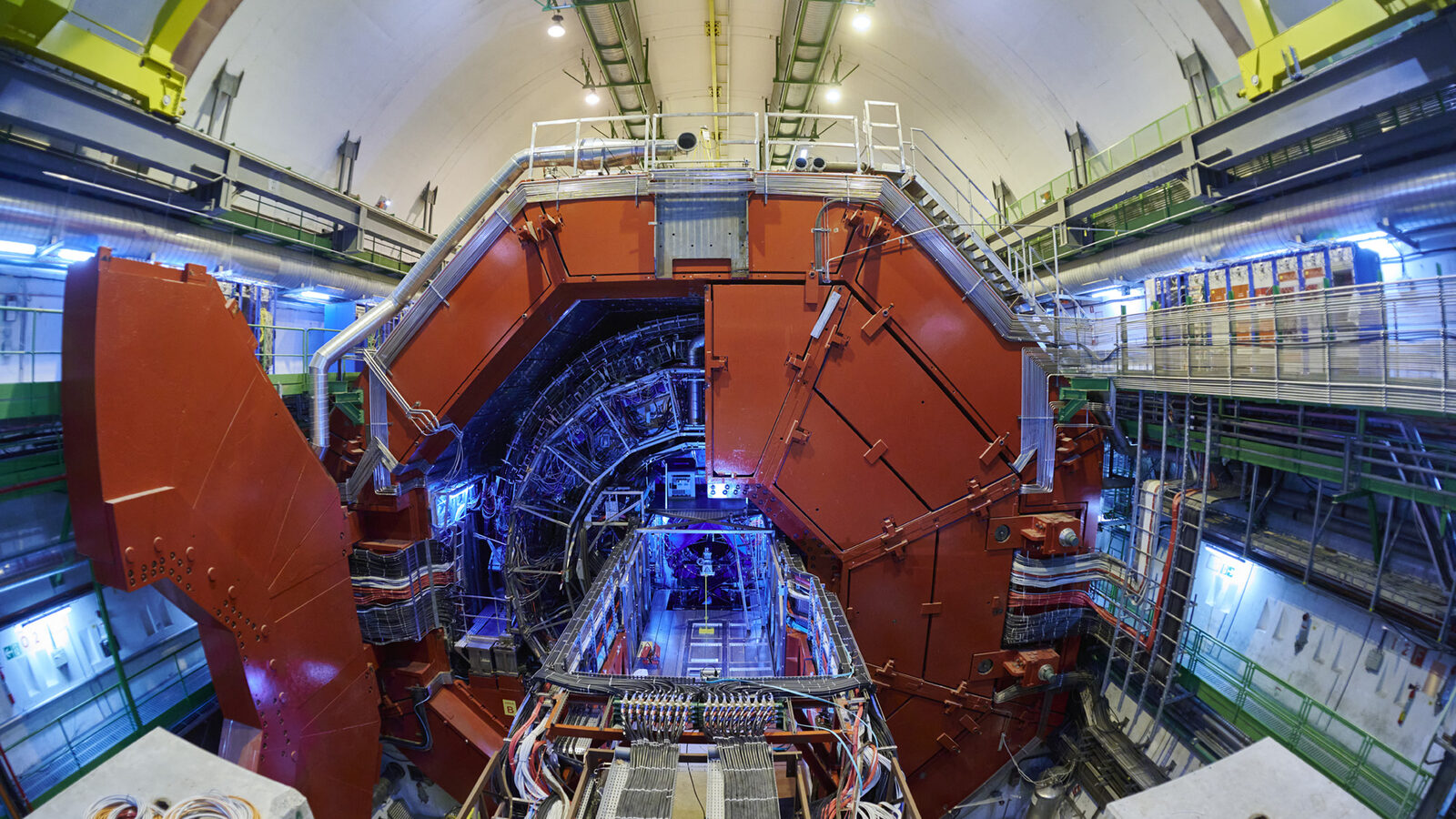
In 2023, the ALICE experiment was ready for their best year yet, until a mysterious signal threatened everything. As the LHC wraps up its 2025 lead-ion run, physicists recall how they worked together to solve the puzzle.
In less than three years, scientists will start up the world's largest scientific instrument: The Large Hadron Collider. US scientists have built key components for the machine and its experiments, paving the way for their participation in a decade of discoveries.
In January 2000, Tom Jordan had just finished up a conference in San Diego, where he had presented one of the new cosmic ray detectors to QuarkNet teachers.
Because particle physicists cannot directly see the objects they study, they rely on deduction and decay products to detect nature's tiny, ephemeral particles.
Custom designed microchips have become essential in processing signals from modern physics experiments that generate lots of data. This chip, the QIE9, designed by Fermilab engineers, is just one example of the many Application Specific Integrated Circuits (ASICs) used in such experiments.
Fermilab's new Girl Scout badge has troop #312 excited about "atoms and buffalo." Unlike a field trip where kids visit Fermilab to learn about physics in an "educational environment," the Girl Scouts' Fermilab outing lets kids come with their friends and a scout lead