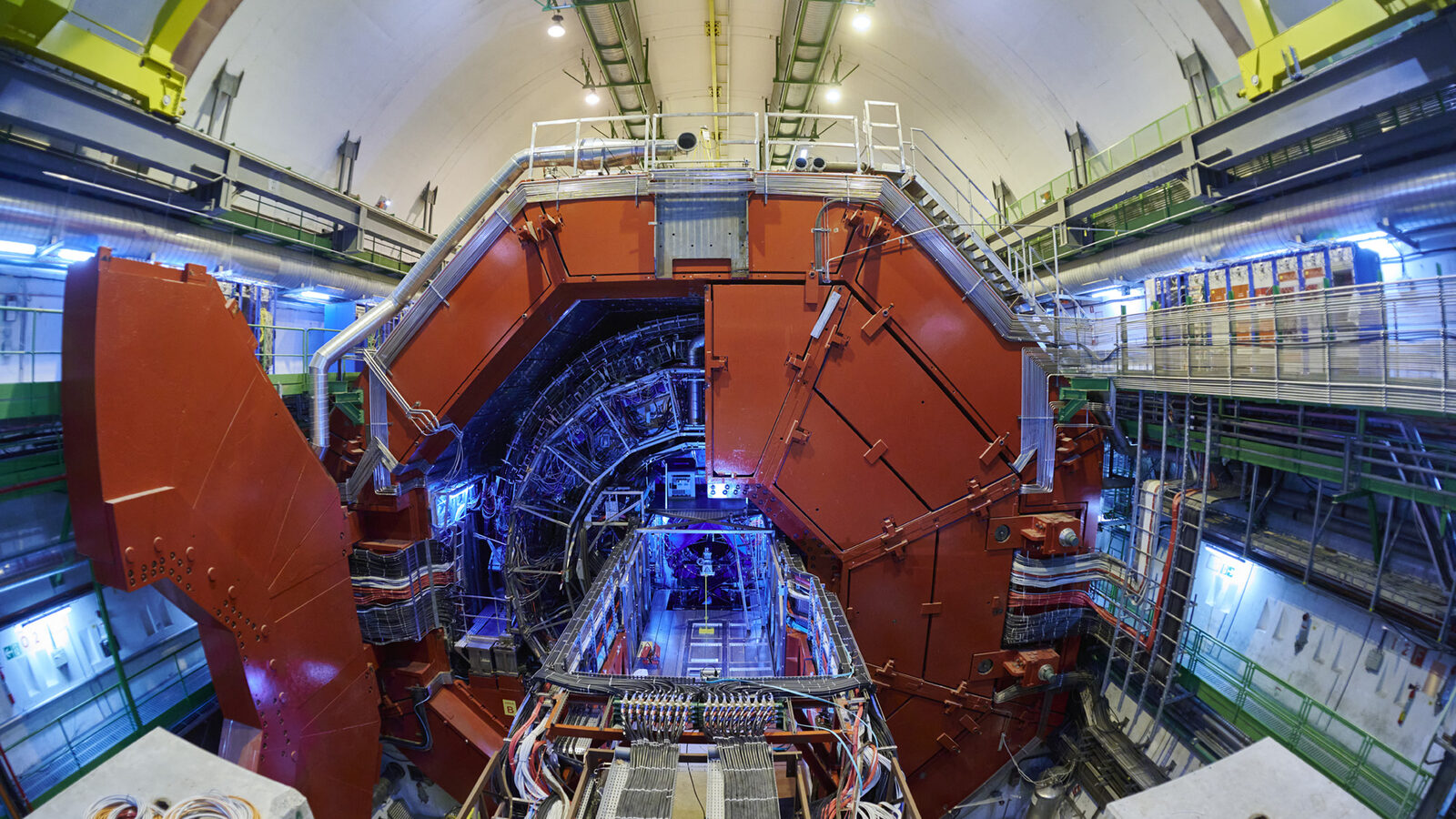
In 2023, the ALICE experiment was ready for their best year yet, until a mysterious signal threatened everything. As the LHC wraps up its 2025 lead-ion run, physicists recall how they worked together to solve the puzzle.
Every winter, pine trees on the KEK campus in Tsukuba, Japan, get a treat. Komomaki (woven-straw blankets) are wrapped around the pines a few feet above the ground.
In honor of the World Year of Physics, symmetry featured an Albert Einstein teddy bear on the cover of the February issue. Since then, we have received a steady stream of phone calls and email.
The CMS (Compact Muon Solenoid) detector at CERN, in Geneva, Switzerland, and the new CMS offices at Fermilab are separated only by the amount of time it takes light to travel between the two places.
Because particle physicists cannot directly see the objects they study, they rely on deduction and decay products to detect nature's tiny, ephemeral particles.
Custom designed microchips have become essential in processing signals from modern physics experiments that generate lots of data. This chip, the QIE9, designed by Fermilab engineers, is just one example of the many Application Specific Integrated Circuits (ASICs) used in such experiments.
Fermilab's new Girl Scout badge has troop #312 excited about "atoms and buffalo." Unlike a field trip where kids visit Fermilab to learn about physics in an "educational environment," the Girl Scouts' Fermilab outing lets kids come with their friends and a scout lead