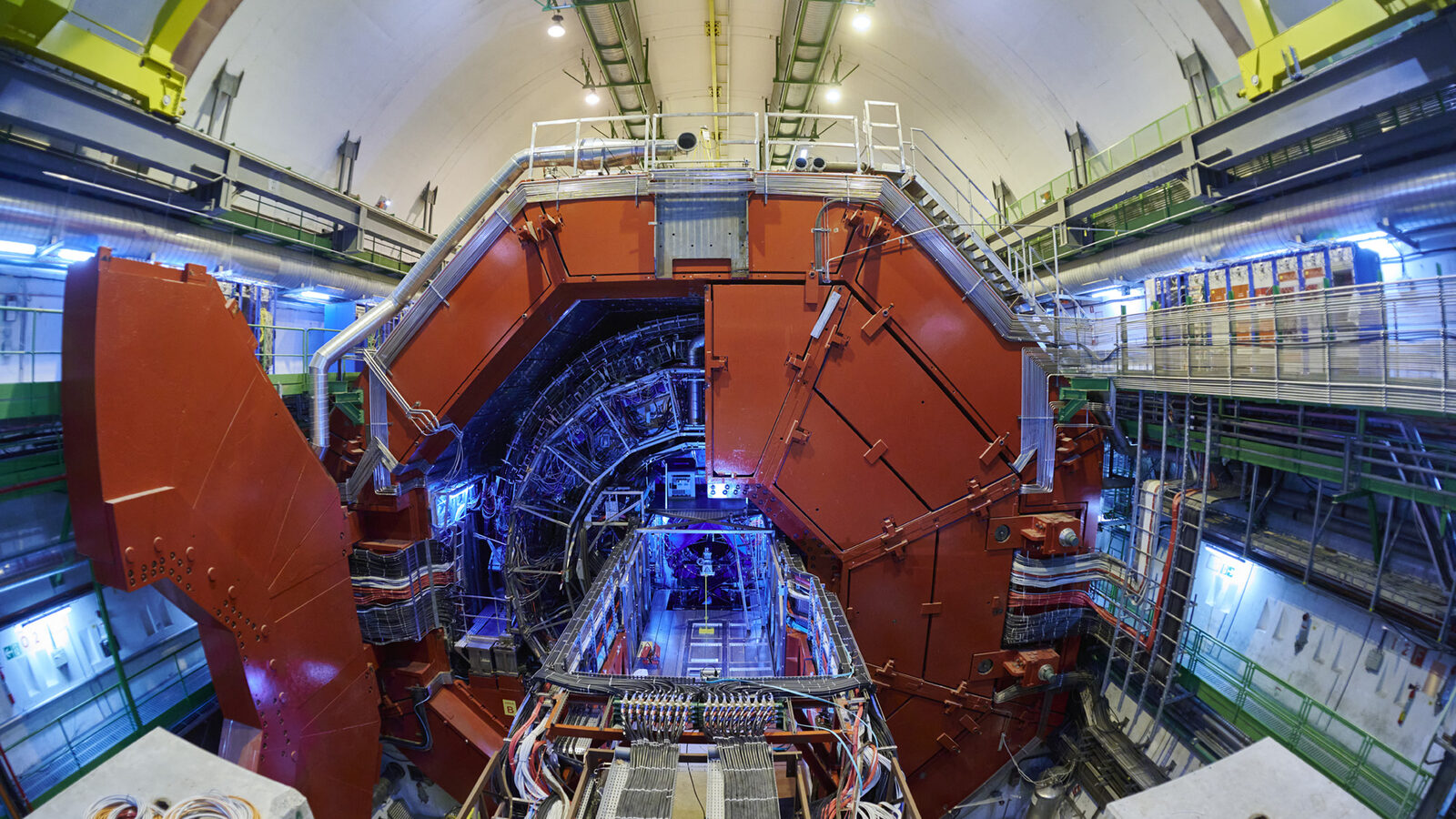
In 2023, the ALICE experiment was ready for their best year yet, until a mysterious signal threatened everything. As the LHC wraps up its 2025 lead-ion run, physicists recall how they worked together to solve the puzzle.
Mario Calvetti of the University of Florence has been named the new director of Frascati National Laboratories by Italy's Istituto Nazionale di Fisica Nucleare (INFN), marking a return to the origins of his scientific career.
The CMS (Compact Muon Solenoid) detector at CERN, in Geneva, Switzerland, and the new CMS offices at Fermilab are separated only by the amount of time it takes light to travel between the two places.
In January 2000, Tom Jordan had just finished up a conference in San Diego, where he had presented one of the new cosmic ray detectors to QuarkNet teachers.
I have heard conflicting reports as to who decided to call one of the most spectacular intellectual innovations of human history "the Standard Model," physicists' best construct for explaining the range and behavior of elementary particles that make up the universe as we know it.
Because particle physicists cannot directly see the objects they study, they rely on deduction and decay products to detect nature's tiny, ephemeral particles.
Fermilab's new Girl Scout badge has troop #312 excited about "atoms and buffalo." Unlike a field trip where kids visit Fermilab to learn about physics in an "educational environment," the Girl Scouts' Fermilab outing lets kids come with their friends and a scout lead