By demonstrating through experiment the reality of quarks, Taylor helped lay the foundation of what scientists know as the Standard Model of particle physics.
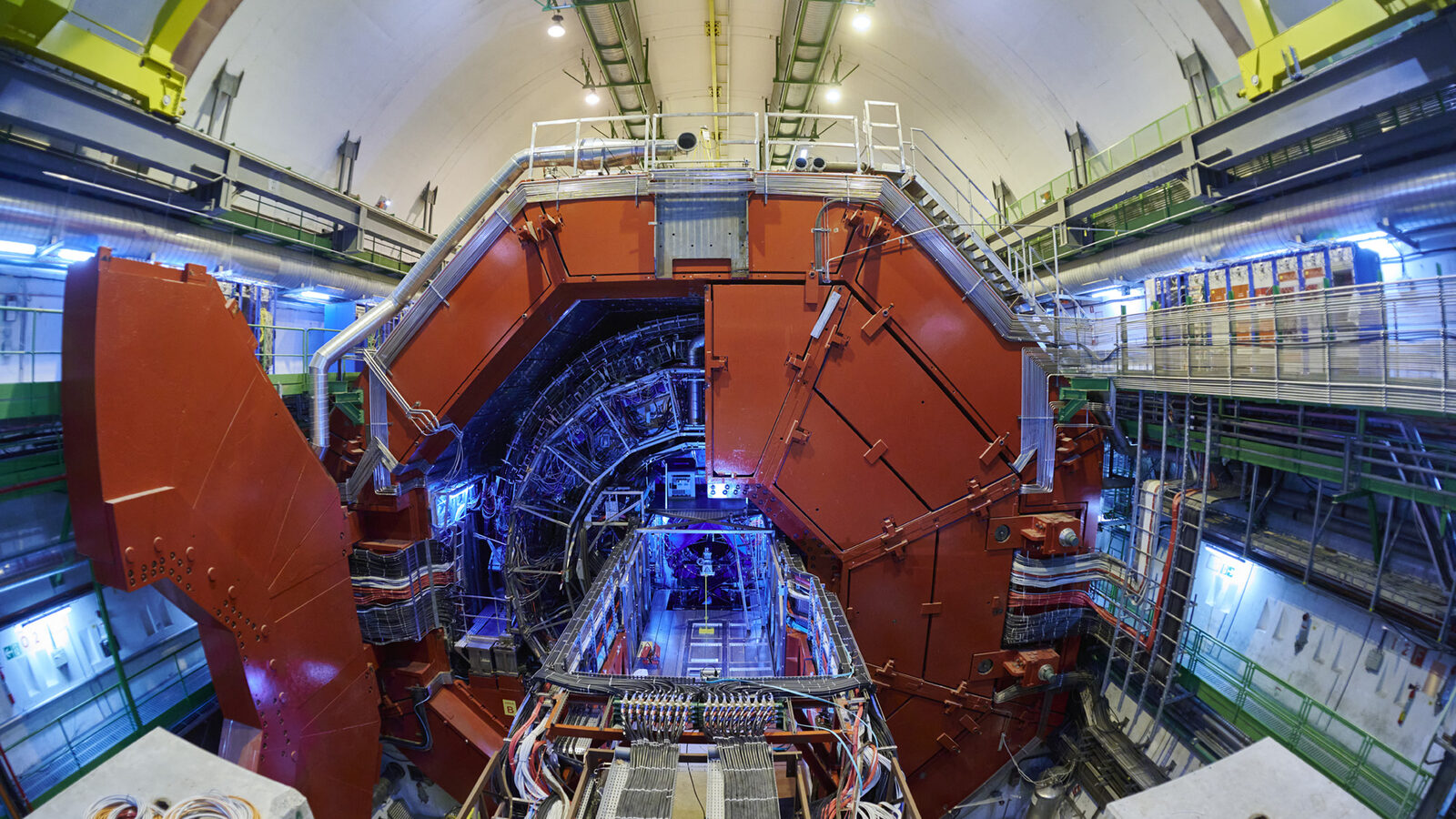
In 2023, the ALICE experiment was ready for their best year yet, until a mysterious signal threatened everything. As the LHC wraps up its 2025 lead-ion run, physicists recall how they worked together to solve the puzzle.
The most-cited paper in theoretical particle physics in 2004 was "A large mass hierarchy from a small extra dimension" by Lisa Randall and Raman Sundrum, published in Physical Review Letters in 1999.
"It's funny to see how people react to it. Non-technical people steer wide and won't touch it, while engineers and designers, people you wouldn't think of as given to humor, will stand in front of it until it moves around or put a handkerchief on the wireless camera.
The future of Stanford Linear Accelerator Center involves a broadening from traditional particle physics experiments to research from subatomic to cosmological scales.
When was the last time you met three Einsteins? Masa Hokari and his son Harumi had this opportunity during Stanford University's Community Day, held in April.
Tomorrow's particle physics experiments are redrawing the map for scientific collaboration. Although the field has long been accustomed to large groups of scientists, life in the new CERN collaborations will surely be different.