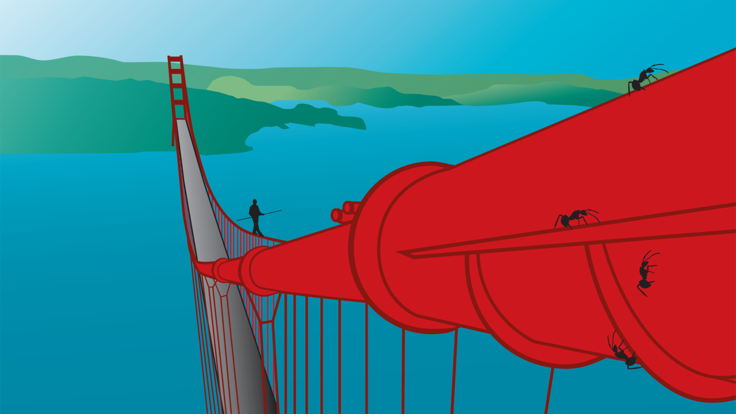
By demonstrating through experiment the reality of quarks, Taylor helped lay the foundation of what scientists know as the Standard Model of particle physics.
When was the last time you met three Einsteins? Masa Hokari and his son Harumi had this opportunity during Stanford University's Community Day, held in April.
Robert Wilson, the first director of Fermilab, was both scientist and artist. There are many anecdotes about his interest in and promotion of art at Fermilab. Over many years I have observed that physical scientists often have a deep interest in the arts.
The most-cited paper in theoretical particle physics in 2004 was "A large mass hierarchy from a small extra dimension" by Lisa Randall and Raman Sundrum, published in Physical Review Letters in 1999.
"It's funny to see how people react to it. Non-technical people steer wide and won't touch it, while engineers and designers, people you wouldn't think of as given to humor, will stand in front of it until it moves around or put a handkerchief on the wireless camera.
Whether climbing trees with her eight-year-old son Isaac, trying to put a dress on her four-year-old daughter Sonia, or running tests on the MINOS neutrino beam line, Debbie Harris is a problem solver and her mind is always busy. "It's really hard to be a parent," she says.