Scientists on the Axion Dark Matter Experiment have demonstrated technology that could lead to the discovery of theoretical light dark matter particles called axions.
In August 2005 nearly seven hundred physicists and engineers from around the world traveled to the small Rocky Mountain town of Snowmass, Colorado, to advance the planning and design of the proposed International Linear Collider.
After darkness sets in each night, a wall of TV monitors in the control room of Apache Point Observatory continually displays the telescope's view of the heavens.
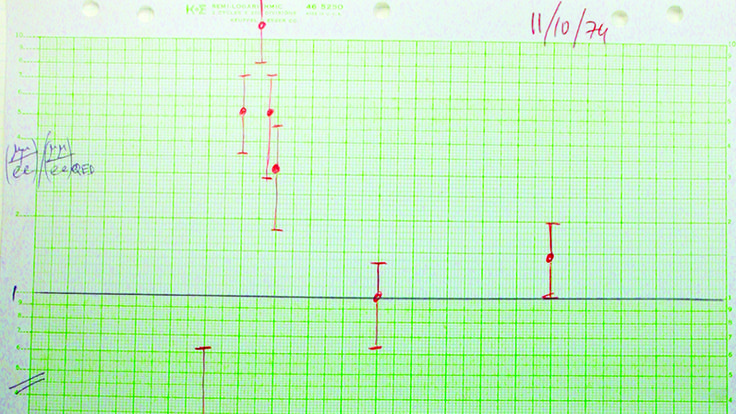
Burton Richter’s group double-checked what they thought was a minor statistical inconsistency in their data. Using the Stanford Positron Electron Accelerating Ring (SPEAR), they probed electron-positron collision energies around 3.1 GeV.
Louis Barrett, physicist at Western Washington University, drives a lot. His daily commute to the university, located in Bellingham, Washington, is more than 80 miles.
Almost in time with the rhythmic open-mouthed chewing and the occasional call for more ketchup during lunchtime at Fermilab's day care center comes the repeated mantra, "Careful of your milk."