Scientists on the Axion Dark Matter Experiment have demonstrated technology that could lead to the discovery of theoretical light dark matter particles called axions.
Nearly 700 physicists from around the world met in Snowmass, Colorado, to advance plans to create an International Linear Collider, a next generation machine that would answer the most fundamental questions about the universe.
Like climbers assessing a new route before making the ascent, physicists have been looking for footholds on a vertiginous new terrain. These footholds contain important information for trekking to TeV heights (the lofty trillion electron volts energy scales of future colliders).
After darkness sets in each night, a wall of TV monitors in the control room of Apache Point Observatory continually displays the telescope's view of the heavens.
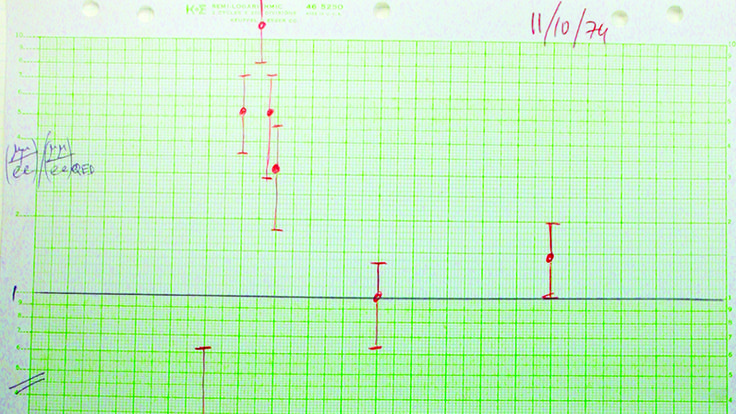
Burton Richter’s group double-checked what they thought was a minor statistical inconsistency in their data. Using the Stanford Positron Electron Accelerating Ring (SPEAR), they probed electron-positron collision energies around 3.1 GeV.
The SLAC archives, in the windowless basement of the Central Laboratory Annex, are no greenhouse. Yet for the past few years, a small tree has adorned the den of SLAC's archivist Jean Deken.
More than 500 tons of niobium would go into building the ILC. What's so great about niobium? Where does it come from? And is the Earth's supply going to run out?