Scientists on the Axion Dark Matter Experiment have demonstrated technology that could lead to the discovery of theoretical light dark matter particles called axions.
After darkness sets in each night, a wall of TV monitors in the control room of Apache Point Observatory continually displays the telescope's view of the heavens.
Public participation is a critical issue for planners of the proposed International Linear Collider. The recent Snowmass conference included a daylong session titled, "Workshop on Public Participation in the ILC," sponsored by the US Linear Collider Communication Committee.
In August 2005 nearly seven hundred physicists and engineers from around the world traveled to the small Rocky Mountain town of Snowmass, Colorado, to advance the planning and design of the proposed International Linear Collider.
Few facets of nature are more mysterious than the quantum world. Particles that appear and disappear from nothing, interactions governed by probability, and intrinsic uncertainties are enough to baffle even the most experienced scientist.
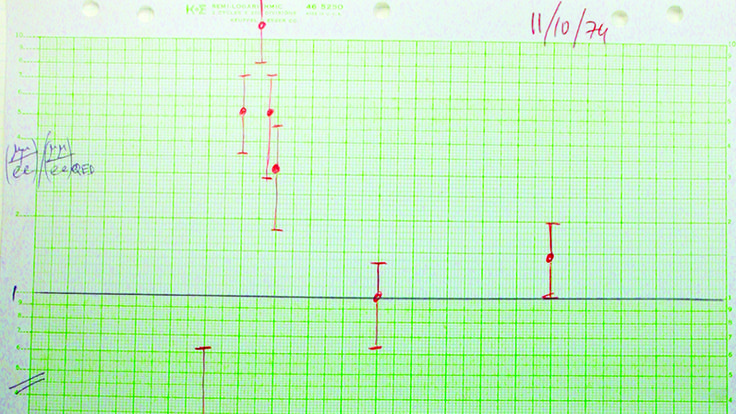
Burton Richter’s group double-checked what they thought was a minor statistical inconsistency in their data. Using the Stanford Positron Electron Accelerating Ring (SPEAR), they probed electron-positron collision energies around 3.1 GeV.
The SLAC archives, in the windowless basement of the Central Laboratory Annex, are no greenhouse. Yet for the past few years, a small tree has adorned the den of SLAC's archivist Jean Deken.
Travel is an integral part of the life and work of particle physicists. Since the beginning of the year, some 30 physicists known as the Quantum Diarists have criss-crossed the world to meet collaborators at distant accelerators, attend conferences, teach a seminar, or interview for jobs.