Scientists on the Axion Dark Matter Experiment have demonstrated technology that could lead to the discovery of theoretical light dark matter particles called axions.
The amazing properties of spider webs have fascinated scientists for years. Some of the mysteries of the spider's thread (such as the radii and spirals of threads produced by the Nephila pilips spider shown above) are unraveling through the use of synchrotron light sources.
Few facets of nature are more mysterious than the quantum world. Particles that appear and disappear from nothing, interactions governed by probability, and intrinsic uncertainties are enough to baffle even the most experienced scientist.
In August 2005 nearly seven hundred physicists and engineers from around the world traveled to the small Rocky Mountain town of Snowmass, Colorado, to advance the planning and design of the proposed International Linear Collider.
Nearly 700 physicists from around the world met in Snowmass, Colorado, to advance plans to create an International Linear Collider, a next generation machine that would answer the most fundamental questions about the universe.
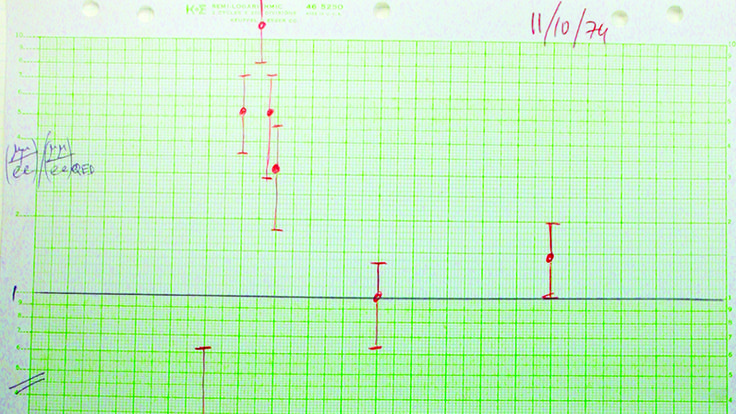
Burton Richter’s group double-checked what they thought was a minor statistical inconsistency in their data. Using the Stanford Positron Electron Accelerating Ring (SPEAR), they probed electron-positron collision energies around 3.1 GeV.
The SLAC archives, in the windowless basement of the Central Laboratory Annex, are no greenhouse. Yet for the past few years, a small tree has adorned the den of SLAC's archivist Jean Deken.
SPIRES is not only an archive for scientific papers; it also provides information on researchers. The HEPNames database contains the names and verified records of over 7000 high-energy physicists, from graduate student to professor emeritus.