Scientists on the Axion Dark Matter Experiment have demonstrated technology that could lead to the discovery of theoretical light dark matter particles called axions.
Like climbers assessing a new route before making the ascent, physicists have been looking for footholds on a vertiginous new terrain. These footholds contain important information for trekking to TeV heights (the lofty trillion electron volts energy scales of future colliders).
After darkness sets in each night, a wall of TV monitors in the control room of Apache Point Observatory continually displays the telescope's view of the heavens.
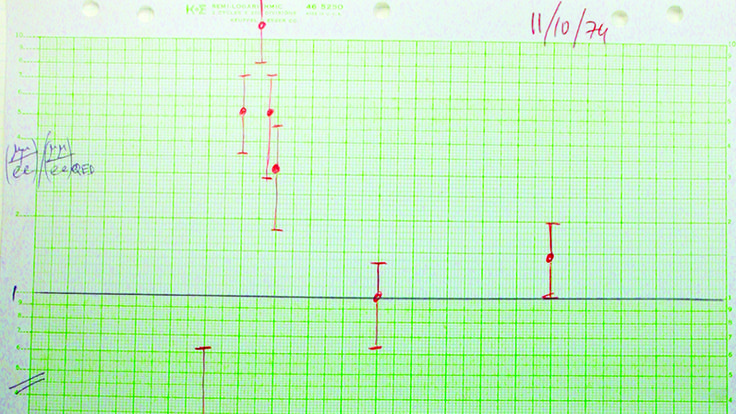
Burton Richter’s group double-checked what they thought was a minor statistical inconsistency in their data. Using the Stanford Positron Electron Accelerating Ring (SPEAR), they probed electron-positron collision energies around 3.1 GeV.
Louis Barrett, physicist at Western Washington University, drives a lot. His daily commute to the university, located in Bellingham, Washington, is more than 80 miles.
Almost in time with the rhythmic open-mouthed chewing and the occasional call for more ketchup during lunchtime at Fermilab's day care center comes the repeated mantra, "Careful of your milk."