Scientists on the Axion Dark Matter Experiment have demonstrated technology that could lead to the discovery of theoretical light dark matter particles called axions.
In need of a computer monitor? How about a forklift? Or maybe a sousaphone? If you are working for the US federal government or an approved agency, all this and more is available to your organization—for merely the cost of shipping a few boxes or a crate.
The amazing properties of spider webs have fascinated scientists for years. Some of the mysteries of the spider's thread (such as the radii and spirals of threads produced by the Nephila pilips spider shown above) are unraveling through the use of synchrotron light sources.
Nearly 700 physicists from around the world met in Snowmass, Colorado, to advance plans to create an International Linear Collider, a next generation machine that would answer the most fundamental questions about the universe.
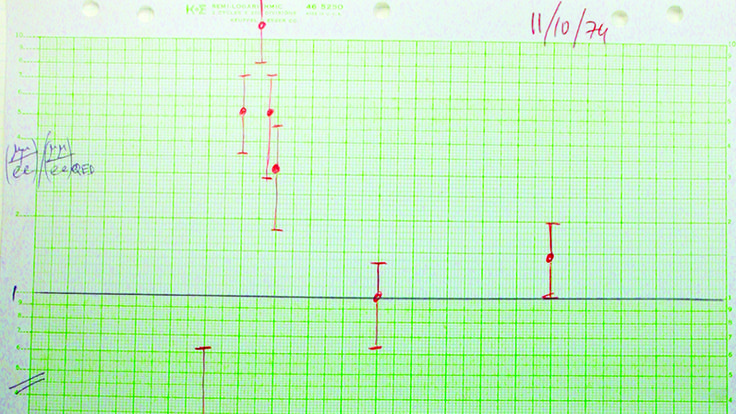
Burton Richter’s group double-checked what they thought was a minor statistical inconsistency in their data. Using the Stanford Positron Electron Accelerating Ring (SPEAR), they probed electron-positron collision energies around 3.1 GeV.
Michael Salamon brings an outward vision to Office of Science and Technology Policy. He says Walt Whitman got it wrong: the more one learns about nature, the more beautiful it becomes.