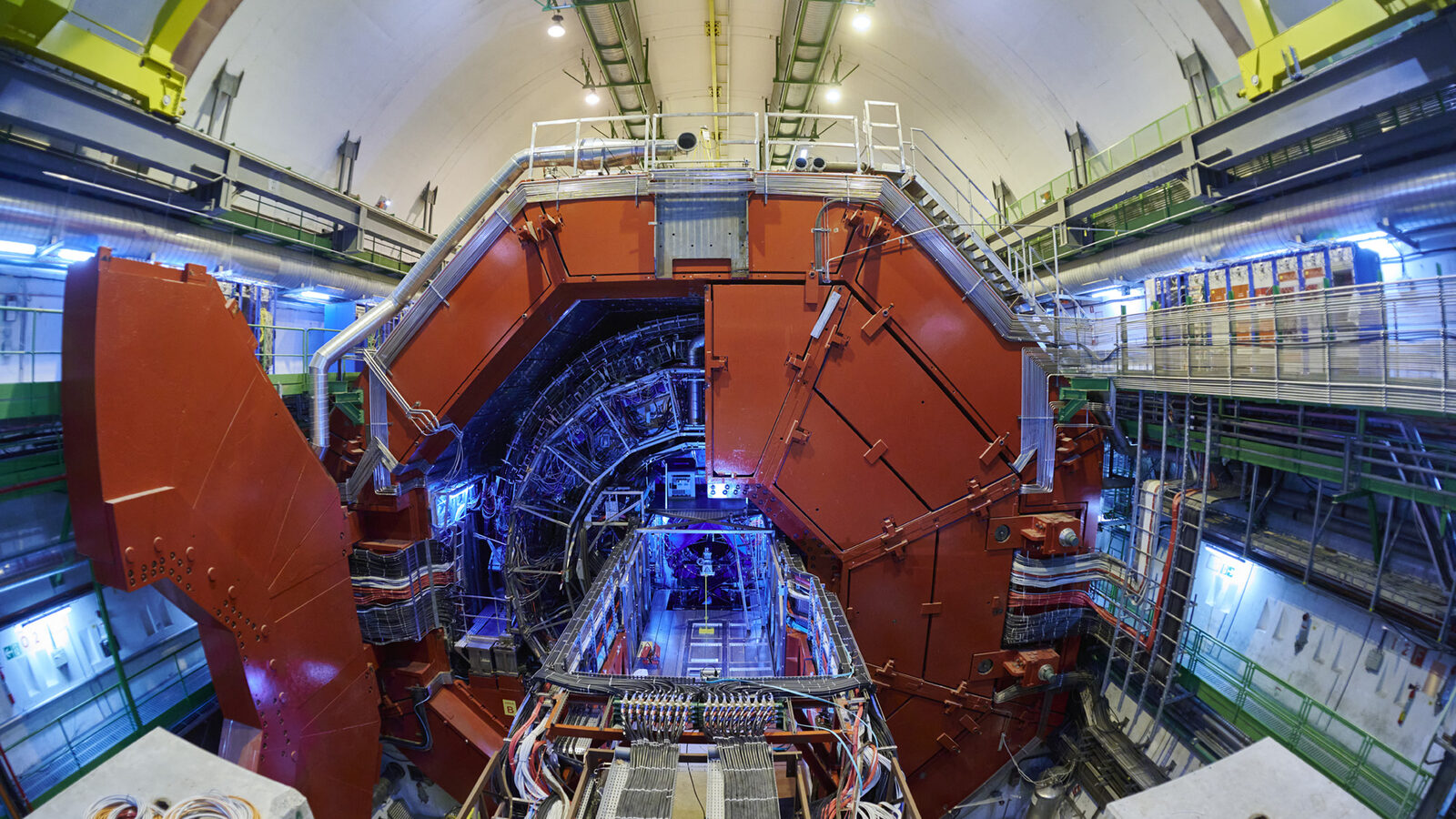
In 2023, the ALICE experiment was ready for their best year yet, until a mysterious signal threatened everything. As the LHC wraps up its 2025 lead-ion run, physicists recall how they worked together to solve the puzzle.
Although we now think of the universe as three bulky, nearly-flat dimensions, we might soon discover that the fabric of space-time consists of many more dimensions than we ever dreamed.
Today's cutting-edge scientific projects are larger, more complex, and more expensive than ever. Grid computing provides the resources that allow researchers to share knowledge, data, and computer processing power across boundaries.
A piece of steel may look cold and lifeless. But like any other piece of matter, it is bursting with activity deep inside. Electrons whiz around inside atoms, and a sea of never-resting quarks and gluons populates the nucleons that make up the atomic core.
All fields of science benefit from more resources and better collaboration, so it's no surprise that scientific researchers are among the first to explore the potential of grid computing to connect people, tools, and technology.