In addition to serving as director of a major Department of Energy laboratory, he also became known in his later years for other contributions to academic and public life.
Few parts of the world would relish a revisiting of conditions from nearly 200 years ago. For Asia, approximating the past could be the key to the future.
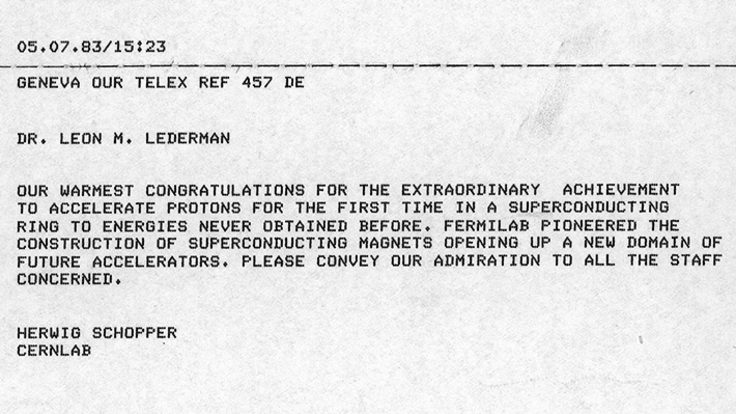
The Tevatron accelerator at Fermilab set a world record on Sunday afternoon, July 3, 1983, achieving a beam energy of 512 billion electronvolts (GeV). Accelerator operators had made the first-ever attempt at accelerating a beam in the Tevatron at 3:12 a.m. that day, reaching 250 GeV.
During a recent trip to CERN on the Franco-Swiss border, my fellow International Linear Collider communicators and I gathered in the cafeteria for tea and coffee.
Here they measure the time not in minutes or hours. Instead they think in terms of how many antiprotons are ready to stack and how soon the Tevatron will be ready to accept new beam. Or how fast they need to fix something, any time of the day or night. Or how long they can stay awake.