In addition to serving as director of a major Department of Energy laboratory, he also became known in his later years for other contributions to academic and public life.
The Australian Synchrotron fits into the larger Australian and international research programs. Newly established e-Research Centres will link to the AS as part of the national data grid, allowing for remote collaboration and operation of the facility.
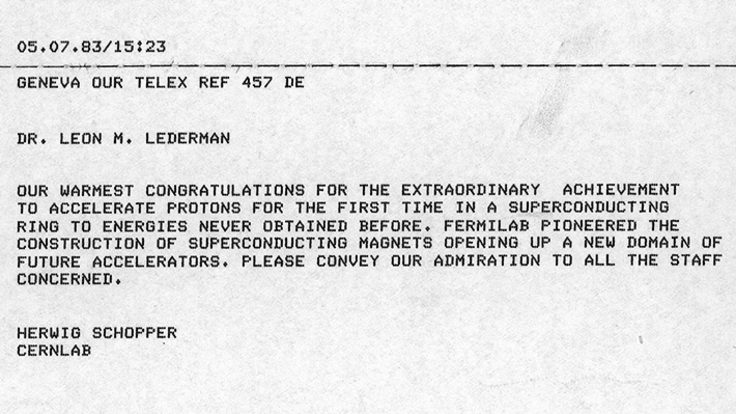
The Tevatron accelerator at Fermilab set a world record on Sunday afternoon, July 3, 1983, achieving a beam energy of 512 billion electronvolts (GeV). Accelerator operators had made the first-ever attempt at accelerating a beam in the Tevatron at 3:12 a.m. that day, reaching 250 GeV.
The Stanford Linear Accelerator pumps large amounts of energy into beams of electrons and positrons, sending them into the PEP-II storage ring where the particles can collide, revealing the secrets of fundamental particle processes.
During a recent trip to CERN on the Franco-Swiss border, my fellow International Linear Collider communicators and I gathered in the cafeteria for tea and coffee.