In addition to serving as director of a major Department of Energy laboratory, he also became known in his later years for other contributions to academic and public life.
A step away from the cars scuttling down the streets of Delhi, precisely arranged on a tame green lawn, is what looks like a giant's playground. Twin cylinders squat at the far end. A pole stands at the center of each, matching the windowed cylinders' radii and heights.
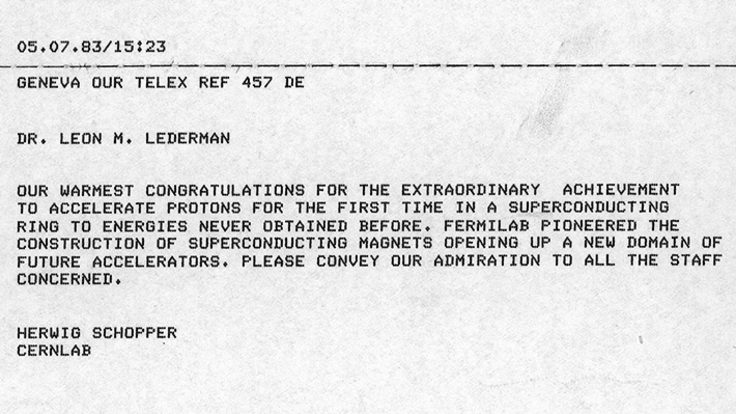
The Tevatron accelerator at Fermilab set a world record on Sunday afternoon, July 3, 1983, achieving a beam energy of 512 billion electronvolts (GeV). Accelerator operators had made the first-ever attempt at accelerating a beam in the Tevatron at 3:12 a.m. that day, reaching 250 GeV.
Here they measure the time not in minutes or hours. Instead they think in terms of how many antiprotons are ready to stack and how soon the Tevatron will be ready to accept new beam. Or how fast they need to fix something, any time of the day or night. Or how long they can stay awake.
In biology, there is a loose rule of thumb that says the bigger an organism, the longer its life will be. If Fermilab's "Jolly Green Giant" is any indication, the rule may also apply to equipment in high-energy physics.
A newly structured High Energy Physics Advisory Panel met in Washington, DC, to provide advice to the Department of Energy and National Science Foundation and to hear science policy-makers’ responses to the President’s budget request.