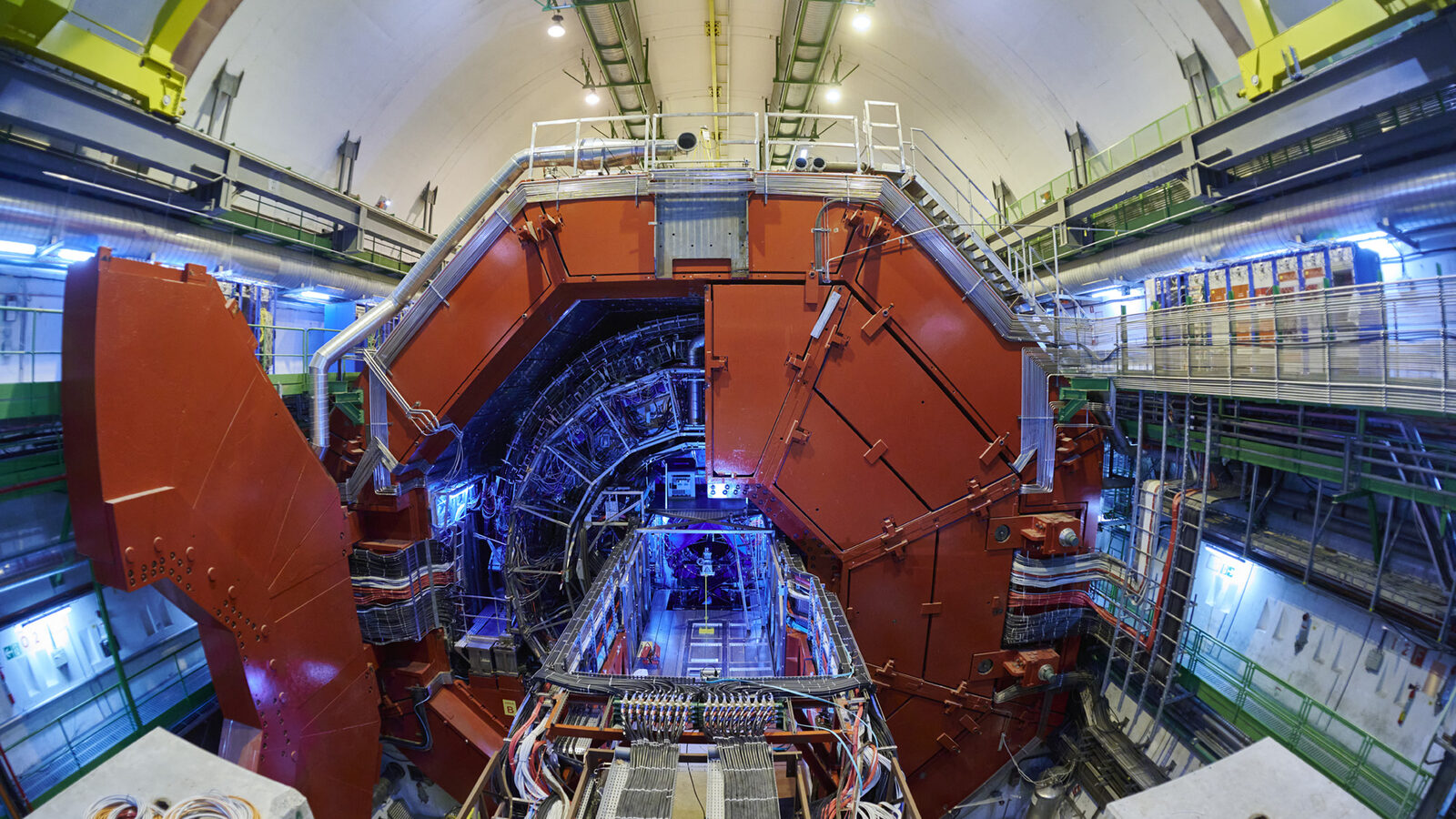
In 2023, the ALICE experiment was ready for their best year yet, until a mysterious signal threatened everything. As the LHC wraps up its 2025 lead-ion run, physicists recall how they worked together to solve the puzzle.
Mesons. Bosons. Pions. Muons. Asparagus. Yes, asparagus. Physicists have spare time, too, and a few of them spend it in Fermilab's Garden Club, with roots almost as old as the lab itself.
The sighting of Jupiter's moons by Galileo Galilei resonates through science and history. Using a handmade telescope in January 1610, Galileo confirmed the Copernican theory that the planets moved around the sun; the Earth was not the center of the solar system.
Street banners honoring nine of Berkeley Lab's Nobel Prize winners, originally installed along Telegraph Avenue in 2003, have been mounted on poles on Cyclotron Road leading to Berkeley Lab in honor of its 75th anniversary.
Neutron scattering research has improved the quality of many everyday items: Shatter-proof windshields, credit cards, pocket calculators, airplanes, compact discs, and magnetic storage tapes are just some examples.
Have you ever tossed a ball at a wall, playing a game of one-man catch? As you tossed that ball again and again and again, have you ever thought about the chance that it could go right through the wall? According to quantum mechanics, this is a real possibility.
Along the Loop Road at Stanford Linear Accelerator Center, the roar of falling water and a refreshing mist filled the air after six solid weeks of California rain. But the water cascading down the inside of Campus Cooling Tower 101, and landing in a frothy pool, is hardly scenic.
Over a half-eaten burrito or a bowl of spaghetti, Sam Ehrenstein ponders the unanswered questions of fundamental physics. Yet Sam is no experimental physicist or postdoc brooding over his data. Not yet, anyway.