The worldwide particle physics community is about to sail on a voyage into a New World of discovery. The Large Hadron Collider, a multi-billion-dollar particle collider that will begin operations in Europe in 2007, will take us into new realms of energy, space, time, and symmetry.
This August, one hundred and fifty postdocs and advanced graduate students from around the world will gather on the Illinois prairie to enhance their understanding of particle colliders at the CERN-Fermilab Hadron Collider Physics Summer School.
A proton travels around a 27-kilometer ring at nearly the speed of light. Along with a bunch of other protons, it passes through the hearts of each of a series of detectors more than ten thousand times per second. Then, on one pass, it slams into a proton coming from the other direction.
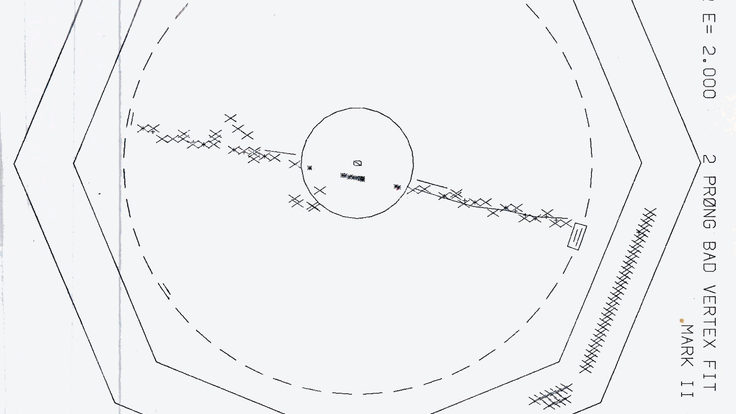
The Positron Electron Project (PEP) collider at the Stanford Linear Accelerator Center produced its first collisions in 1979. All sorts of particles burst out, including the tau lepton, an ephemeral cousin of the electron.
Along the Loop Road at Stanford Linear Accelerator Center, the roar of falling water and a refreshing mist filled the air after six solid weeks of California rain. But the water cascading down the inside of Campus Cooling Tower 101, and landing in a frothy pool, is hardly scenic.
Over a half-eaten burrito or a bowl of spaghetti, Sam Ehrenstein ponders the unanswered questions of fundamental physics. Yet Sam is no experimental physicist or postdoc brooding over his data. Not yet, anyway.
Clouds of electrons could block the view of new discoveries at the proposed ILC, a multi-billion-dollar particle collider. Eliminating those clouds is critical to the prspects for the machine's success.