In a typical high school physics textbook, says scienceeducation specialist Beth Marchant, only the last chapter is devoted to all the developments since 1900–the stuff that physicists are actually working on today.
The Large Hadron Collider, to start up in late 2007, traces its inception back to 1979. There are already more than 4000 papers in the SPIRES database that are about the LHC, either mentioning its name in the title or referring to it in a significant way.
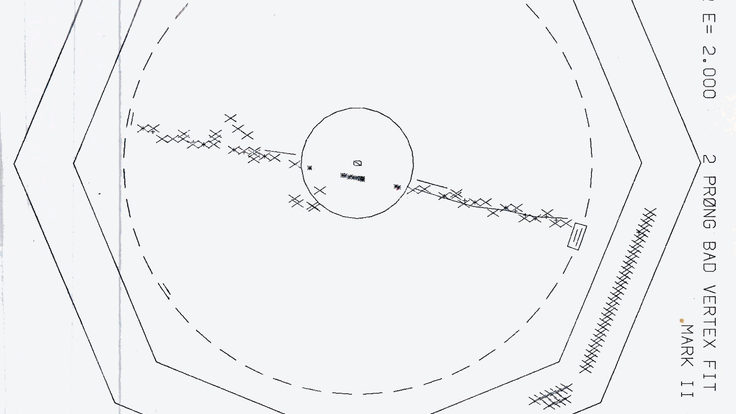
The Positron Electron Project (PEP) collider at the Stanford Linear Accelerator Center produced its first collisions in 1979. All sorts of particles burst out, including the tau lepton, an ephemeral cousin of the electron.
Have you ever tossed a ball at a wall, playing a game of one-man catch? As you tossed that ball again and again and again, have you ever thought about the chance that it could go right through the wall? According to quantum mechanics, this is a real possibility.
Neutron scattering research has improved the quality of many everyday items: Shatter-proof windshields, credit cards, pocket calculators, airplanes, compact discs, and magnetic storage tapes are just some examples.
Along the Loop Road at Stanford Linear Accelerator Center, the roar of falling water and a refreshing mist filled the air after six solid weeks of California rain. But the water cascading down the inside of Campus Cooling Tower 101, and landing in a frothy pool, is hardly scenic.
Over a half-eaten burrito or a bowl of spaghetti, Sam Ehrenstein ponders the unanswered questions of fundamental physics. Yet Sam is no experimental physicist or postdoc brooding over his data. Not yet, anyway.