Walk into the main CERN cafeteria at various times of the day and you'll find different scenes: scientists discussing results over coffee; a parent coaxing his children to finish lunch before swooping them back to the nursery school on site; groups of grad students soaking up the sun on the
The United States has contributed the energy and expertise of hundreds of scientists and engineers, and more than half a billion dollars to the construction of the LHC particle collider and two of its experiments at the European laboratory CERN.
Building the parts for the Large Hadron Collider has presented challenges but taught many lessons for both particle physics laboratories and their industry partners.
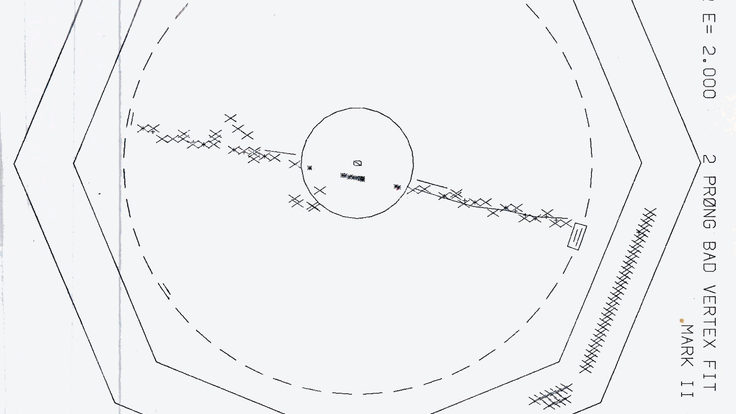
The Positron Electron Project (PEP) collider at the Stanford Linear Accelerator Center produced its first collisions in 1979. All sorts of particles burst out, including the tau lepton, an ephemeral cousin of the electron.
Physics has demonstrated that the everyday phenomena we experience are governed by universal principles applying at time and distance scales far beyond normal human experience.
After undergoing a buffered chemical polishing (BCP) treatment at Cornell University, the first US-processed and tested International Linear Collider superconducting cavity achieved a milestone accelerating gradient of 26 MV/m (megavolts per meter)–surpassing the first gradient goal (25 MV/m).
Welcome to SLAC's End Station B, where work on the International Linear Collider (ILC) will help shape the future of particle physics–although some inhabitants don't seem to give a hoot.