The United States has contributed the energy and expertise of hundreds of scientists and engineers, and more than half a billion dollars to the construction of the LHC particle collider and two of its experiments at the European laboratory CERN.
Building the parts for the Large Hadron Collider has presented challenges but taught many lessons for both particle physics laboratories and their industry partners.
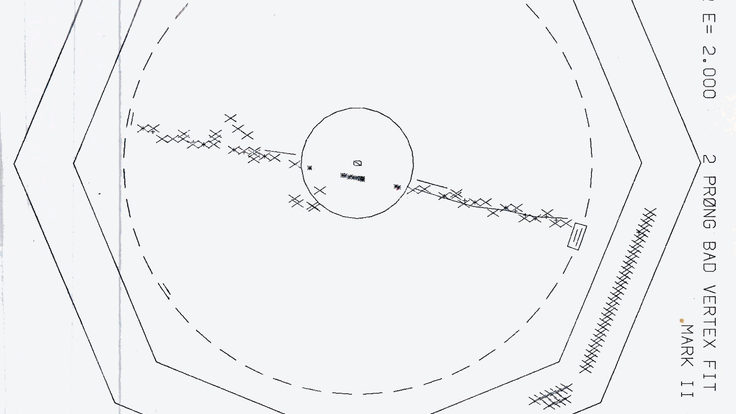
The Positron Electron Project (PEP) collider at the Stanford Linear Accelerator Center produced its first collisions in 1979. All sorts of particles burst out, including the tau lepton, an ephemeral cousin of the electron.
Mesons. Bosons. Pions. Muons. Asparagus. Yes, asparagus. Physicists have spare time, too, and a few of them spend it in Fermilab's Garden Club, with roots almost as old as the lab itself.
Physics has demonstrated that the everyday phenomena we experience are governed by universal principles applying at time and distance scales far beyond normal human experience.
The sighting of Jupiter's moons by Galileo Galilei resonates through science and history. Using a handmade telescope in January 1610, Galileo confirmed the Copernican theory that the planets moved around the sun; the Earth was not the center of the solar system.