To deal with the computing demands of the LHC experiments, scientists have created the world's largest, most international distributed-computing system.
In a typical high school physics textbook, says scienceeducation specialist Beth Marchant, only the last chapter is devoted to all the developments since 1900–the stuff that physicists are actually working on today.
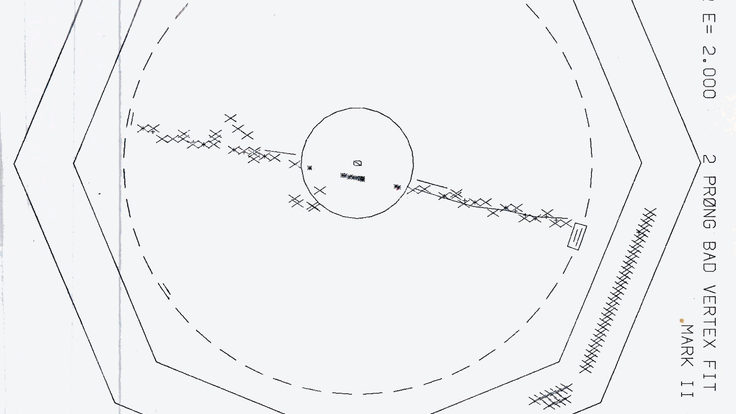
The Positron Electron Project (PEP) collider at the Stanford Linear Accelerator Center produced its first collisions in 1979. All sorts of particles burst out, including the tau lepton, an ephemeral cousin of the electron.
Mesons. Bosons. Pions. Muons. Asparagus. Yes, asparagus. Physicists have spare time, too, and a few of them spend it in Fermilab's Garden Club, with roots almost as old as the lab itself.
Neutron scattering research has improved the quality of many everyday items: Shatter-proof windshields, credit cards, pocket calculators, airplanes, compact discs, and magnetic storage tapes are just some examples.
Street banners honoring nine of Berkeley Lab's Nobel Prize winners, originally installed along Telegraph Avenue in 2003, have been mounted on poles on Cyclotron Road leading to Berkeley Lab in honor of its 75th anniversary.
Have you ever tossed a ball at a wall, playing a game of one-man catch? As you tossed that ball again and again and again, have you ever thought about the chance that it could go right through the wall? According to quantum mechanics, this is a real possibility.