The United States has contributed the energy and expertise of hundreds of scientists and engineers, and more than half a billion dollars to the construction of the LHC particle collider and two of its experiments at the European laboratory CERN.
This August, one hundred and fifty postdocs and advanced graduate students from around the world will gather on the Illinois prairie to enhance their understanding of particle colliders at the CERN-Fermilab Hadron Collider Physics Summer School.
Building the parts for the Large Hadron Collider has presented challenges but taught many lessons for both particle physics laboratories and their industry partners.
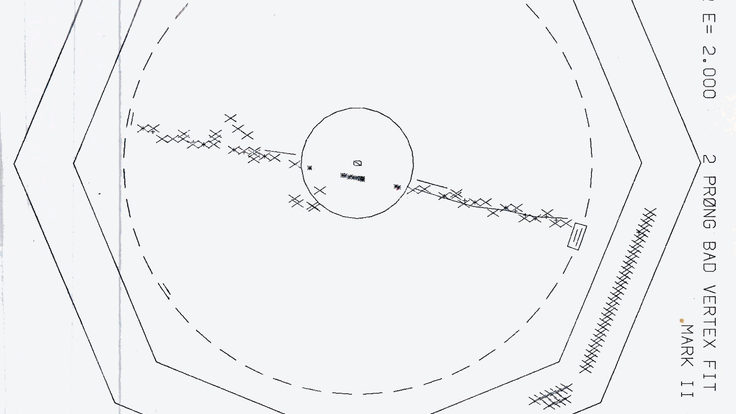
The Positron Electron Project (PEP) collider at the Stanford Linear Accelerator Center produced its first collisions in 1979. All sorts of particles burst out, including the tau lepton, an ephemeral cousin of the electron.
Along the Loop Road at Stanford Linear Accelerator Center, the roar of falling water and a refreshing mist filled the air after six solid weeks of California rain. But the water cascading down the inside of Campus Cooling Tower 101, and landing in a frothy pool, is hardly scenic.
Physics has demonstrated that the everyday phenomena we experience are governed by universal principles applying at time and distance scales far beyond normal human experience.
Over a half-eaten burrito or a bowl of spaghetti, Sam Ehrenstein ponders the unanswered questions of fundamental physics. Yet Sam is no experimental physicist or postdoc brooding over his data. Not yet, anyway.