At a special meeting in Lisbon on July 14, the CERN Council unanimously adopted a 17-point European Strategy for Particle Physics, based on the premise that "Europe should maintain and strengthen its central position in particle physics."
The instrumentation team of Fermilab's Environment, Safety & Health Section is the caretaker of a unique menagerie: albatrosses, chipmunks, hippos, pterodactyls, scarecrows, and an aardvark to name a few.
Cavities propel charged particles by transferring energy from electromagnetic waves to the particles, speeding them up. Superconducting cavities are made of material that can conduct electric currents without resistance at a very low temperature.
There's a new scientific path in Princeton, New Jersey. Out of the loam of a vacant lot, a cluster of quasicrystals winks at some pink plasma. Tectonic plates shift, and neurons connect in a hippocampus curve of bamboo.
The highest-energy particle accelerator in the world, Fermilab's Tevatron, boasts four miles of particle-accelerating circumference. But during thunderstorms it can become a bull's-eye for stray lightning bolts that demonstrate the intimidating power of nature.
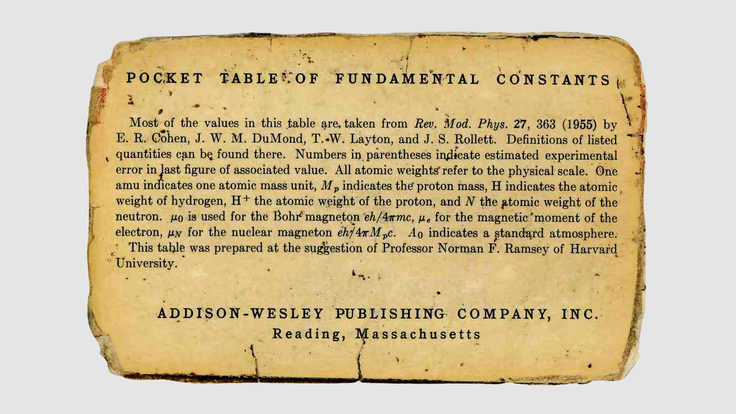
In the early 1950s, Nobel-Laureates-to-be Norman Ramsey and Ed Purcell created cards of physical constants they found themselves using most frequently.