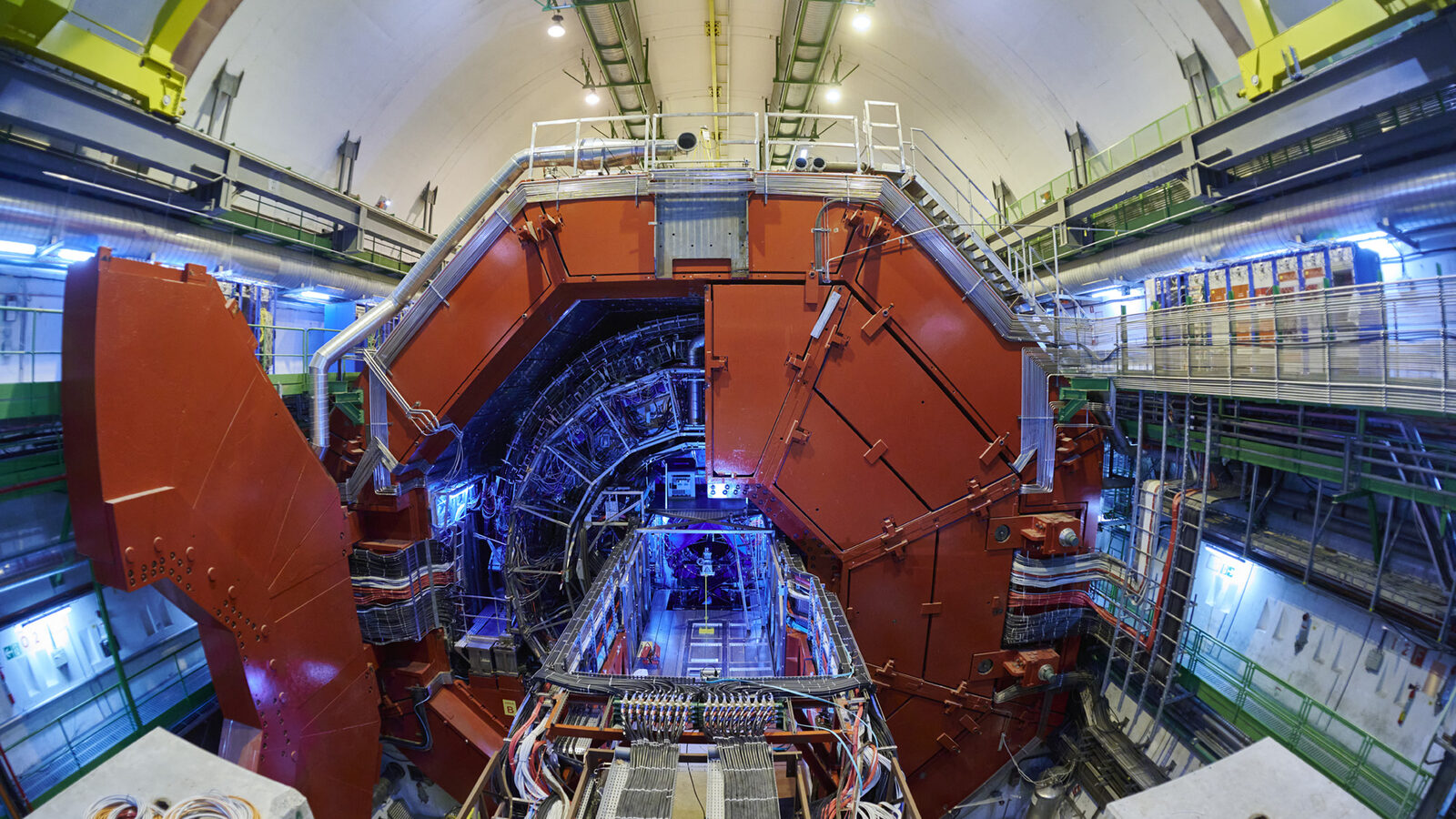
In 2023, the ALICE experiment was ready for their best year yet, until a mysterious signal threatened everything. As the LHC wraps up its 2025 lead-ion run, physicists recall how they worked together to solve the puzzle.
Security officers raise and lower 20 flags in front of Fermilab's Wilson Hall every day. Each flag represents a country that researchers come from to work at the lab. "The problem is that there are twenty flag poles," says Fermilab's Roy Rubinstein.
The big-bang theory of the early universe implies that the universe is immersed in a bath of microwave light, a cooled-down remnant of early high-temperature radiation, invisible to the naked eye.
Cavities propel charged particles by transferring energy from electromagnetic waves to the particles, speeding them up. Superconducting cavities are made of material that can conduct electric currents without resistance at a very low temperature.
From the day it was completed in the early days of Fermilab, the design of the Meson Lab roof has been an aesthetic success and a structural nightmare. It leaks. Always has.
There's a new scientific path in Princeton, New Jersey. Out of the loam of a vacant lot, a cluster of quasicrystals winks at some pink plasma. Tectonic plates shift, and neurons connect in a hippocampus curve of bamboo.
The inaugural beam for the CERN Neutrinos to Gran Sasso (CNGS) project took just 2.5 milliseconds to fly 732 km through the earth from Geneva, Switzerland, to its destination at the Gran Sasso underground laboratory near Rome on Monday, September 11, 2006.
When 20-year-old Ryan Auer set out to find his very first job, he didn't expect to wind up at the Stanford Linear Accelerator Center, let alone on stage in front of over 1000 people at the lab's annual Family Day.