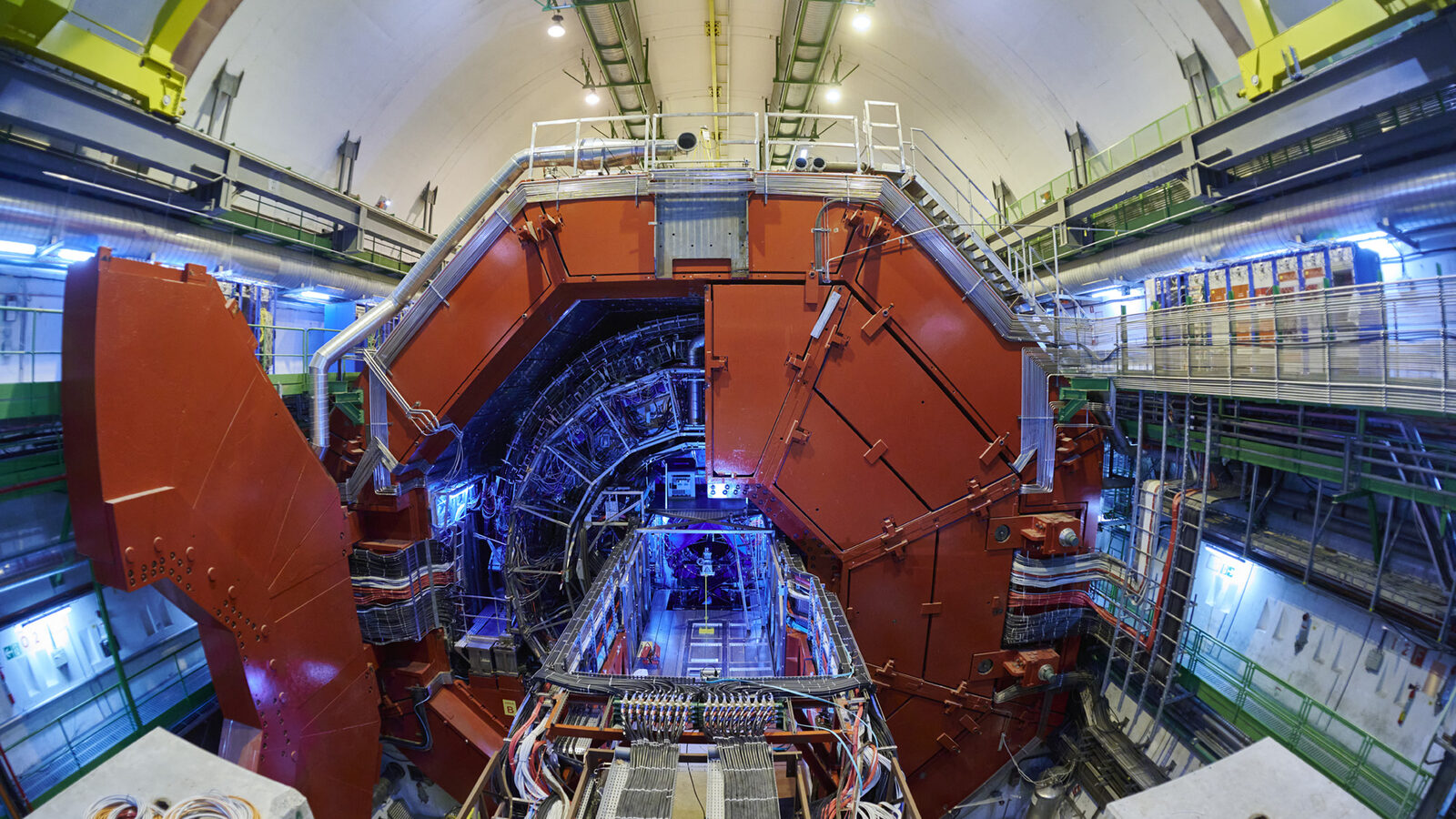
In 2023, the ALICE experiment was ready for their best year yet, until a mysterious signal threatened everything. As the LHC wraps up its 2025 lead-ion run, physicists recall how they worked together to solve the puzzle.
Three-year-old Madeleine Rogers stands inside the spooky remains of a 275-pound pumpkin grown by her father, Stanford Linear Accelerator Center engineer Reggie Rogers.
The big-bang theory of the early universe implies that the universe is immersed in a bath of microwave light, a cooled-down remnant of early high-temperature radiation, invisible to the naked eye.
A little after midnight, foreign voices and scents of dinner drift from the kitchen and down the halls of Dorm 1. Slavic dialogue stirs me from sleep and the aroma of cooked kielbasa sausage grabs my full attention.
Buried deep in the mountains of southern China, a new neutrino experiment would rely on a series of Chinese nuclear reactors and the brains of scientists from several countries.
At a special meeting in Lisbon on July 14, the CERN Council unanimously adopted a 17-point European Strategy for Particle Physics, based on the premise that "Europe should maintain and strengthen its central position in particle physics."
The highest-energy particle accelerator in the world, Fermilab's Tevatron, boasts four miles of particle-accelerating circumference. But during thunderstorms it can become a bull's-eye for stray lightning bolts that demonstrate the intimidating power of nature.
Cavities propel charged particles by transferring energy from electromagnetic waves to the particles, speeding them up. Superconducting cavities are made of material that can conduct electric currents without resistance at a very low temperature.