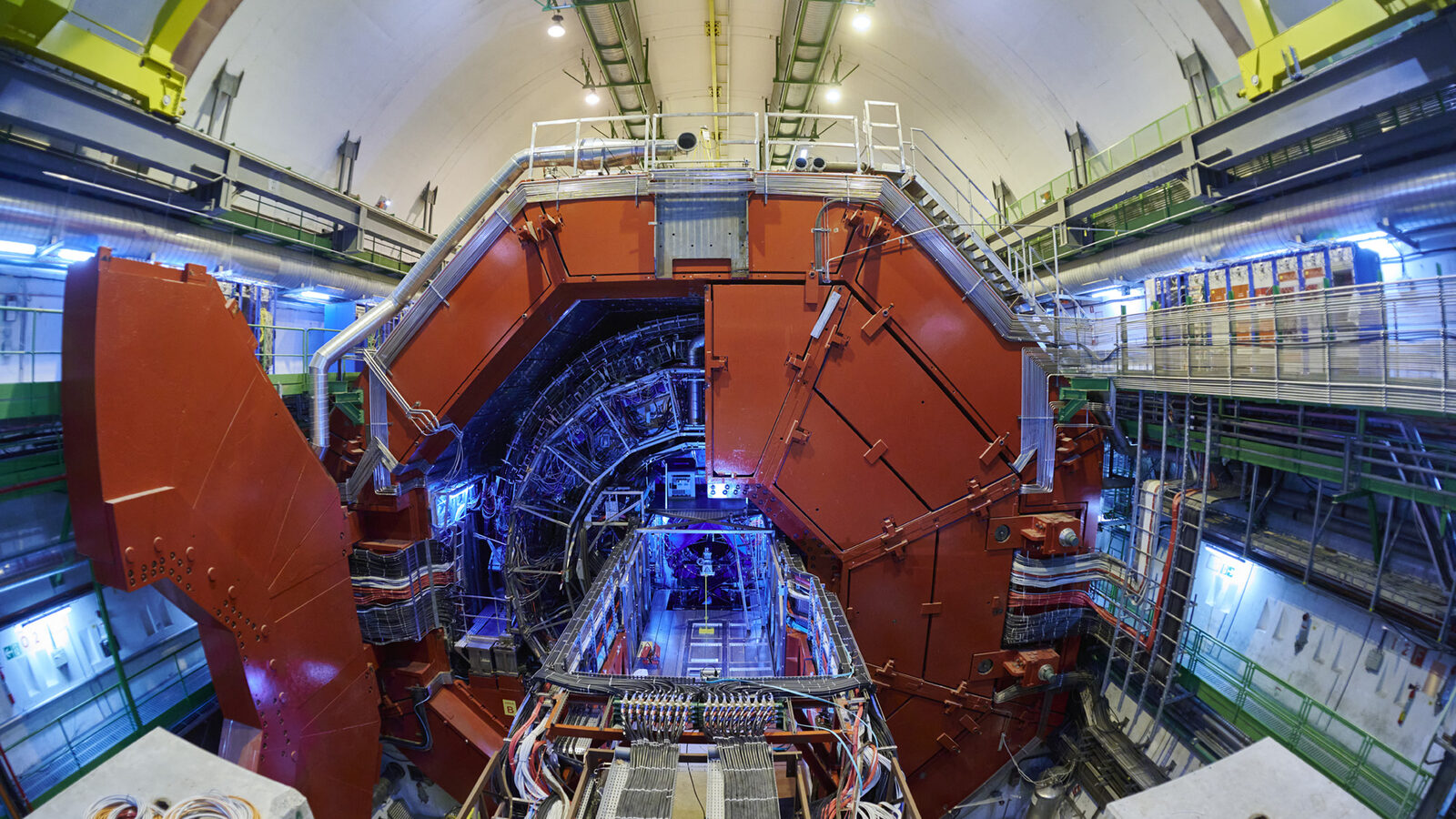
In 2023, the ALICE experiment was ready for their best year yet, until a mysterious signal threatened everything. As the LHC wraps up its 2025 lead-ion run, physicists recall how they worked together to solve the puzzle.
The Japan Proton Accelerator Research Complex (J-PARC) isn't scheduled to open until 2008, but the Tokai campus facility is already the site of discovery—just not of the physics variety.
The big-bang theory of the early universe implies that the universe is immersed in a bath of microwave light, a cooled-down remnant of early high-temperature radiation, invisible to the naked eye.
When 20-year-old Ryan Auer set out to find his very first job, he didn't expect to wind up at the Stanford Linear Accelerator Center, let alone on stage in front of over 1000 people at the lab's annual Family Day.
Cavities propel charged particles by transferring energy from electromagnetic waves to the particles, speeding them up. Superconducting cavities are made of material that can conduct electric currents without resistance at a very low temperature.
The instrumentation team of Fermilab's Environment, Safety & Health Section is the caretaker of a unique menagerie: albatrosses, chipmunks, hippos, pterodactyls, scarecrows, and an aardvark to name a few.
There's a new scientific path in Princeton, New Jersey. Out of the loam of a vacant lot, a cluster of quasicrystals winks at some pink plasma. Tectonic plates shift, and neurons connect in a hippocampus curve of bamboo.