Twenty-five years ago this week, NASA held its collective breath as seven astronauts on space shuttle Endeavour caught up with the Hubble Space Telescope 353 miles above Earth.
I have been attending hundreds of talks by particle physicists who look for a very specific experimental signature that is predicted by a very specific theory extending the Standard Model.
A one-time visitor to SLAC, the Antarctic Impulsive Transient Antenna (ANITA), recently took to the frigid skies over Antarctica on a mission looking for evidence of cosmic-ray neutrinos.
The world, by some accounts, was created in seven days. Not to try and top that, but a university band managed to re-enact the big bang in a period of less than an hour.
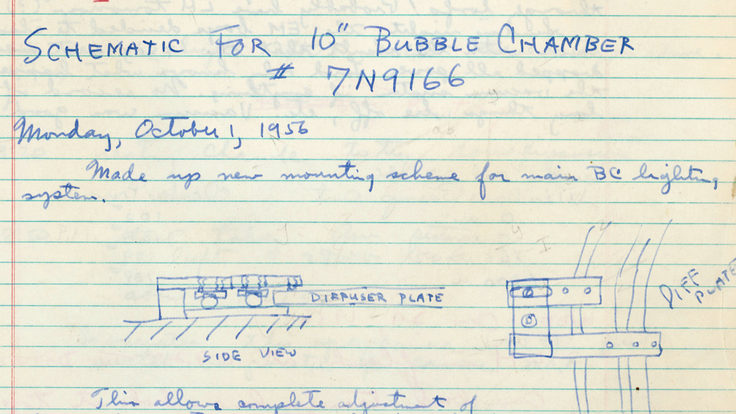
Luis Alvarez, a physicist at what today is the Lawrence Berkeley National Laboratory, attended a 1953 meeting of the American Physical Society and heard a young University of Michigan physicist named Donald Glaser describe a particle detector he’d developed and called a “bubble chambe
Advances in virtual control technology have shown scientists just how important humans are after all. Although scientists can now essentially operate a particle collider from anywhere in the world, having members of a team work well remotely is just as significant a challenge.
Three-year-old Madeleine Rogers stands inside the spooky remains of a 275-pound pumpkin grown by her father, Stanford Linear Accelerator Center engineer Reggie Rogers.