Twenty-five years ago this week, NASA held its collective breath as seven astronauts on space shuttle Endeavour caught up with the Hubble Space Telescope 353 miles above Earth.
The Compact Muon Solenoid (CMS) detector is one of the two general purpose particle detectors being constructed at CERNs Large Hadron Collider (LHC) outside Geneva, Switzerland.
How do you renovate a delicate, irreplaceable detector? Very carefully. During the last four months of 2006, the BaBar collaboration at SLAC successfully replaced a prematurely aging muon identification system.
I have been attending hundreds of talks by particle physicists who look for a very specific experimental signature that is predicted by a very specific theory extending the Standard Model.
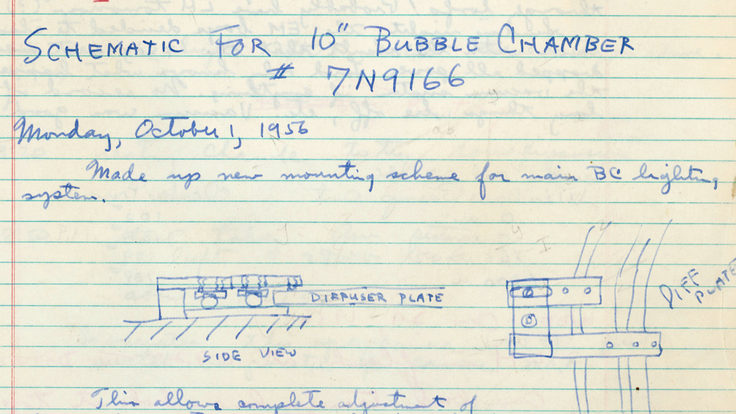
Luis Alvarez, a physicist at what today is the Lawrence Berkeley National Laboratory, attended a 1953 meeting of the American Physical Society and heard a young University of Michigan physicist named Donald Glaser describe a particle detector he’d developed and called a “bubble chambe
Call it subtle irony: The ground breaking for SLAC's Linac Coherent Light Source (LCLS) took place among earth movers that had already been busily transforming the rolling California landscape for weeks.
The Japan Proton Accelerator Research Complex (J-PARC) isn't scheduled to open until 2008, but the Tokai campus facility is already the site of discovery—just not of the physics variety.