Twenty-five years ago this week, NASA held its collective breath as seven astronauts on space shuttle Endeavour caught up with the Hubble Space Telescope 353 miles above Earth.
A one-time visitor to SLAC, the Antarctic Impulsive Transient Antenna (ANITA), recently took to the frigid skies over Antarctica on a mission looking for evidence of cosmic-ray neutrinos.
Guest houses are common among particle physics labs, and the Stanford Linear Accelerator Center is no exception. But in many ways, the Stanford Guest House, situated on the grounds of SLAC, is different.
The world, by some accounts, was created in seven days. Not to try and top that, but a university band managed to re-enact the big bang in a period of less than an hour.
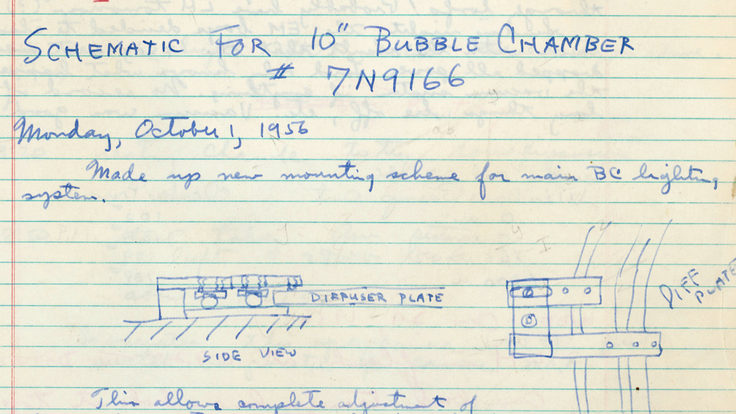
Luis Alvarez, a physicist at what today is the Lawrence Berkeley National Laboratory, attended a 1953 meeting of the American Physical Society and heard a young University of Michigan physicist named Donald Glaser describe a particle detector he’d developed and called a “bubble chambe
If this magnet could talk, you'd hear some amazing stories. During its half-century career, this four-million-pound magnet contributed to experiments that changed our view of physics while serving some of the field's foremost experimenters, including Enrico Fermi.
Advances in virtual control technology have shown scientists just how important humans are after all. Although scientists can now essentially operate a particle collider from anywhere in the world, having members of a team work well remotely is just as significant a challenge.