Twenty-five years ago this week, NASA held its collective breath as seven astronauts on space shuttle Endeavour caught up with the Hubble Space Telescope 353 miles above Earth.
The world, by some accounts, was created in seven days. Not to try and top that, but a university band managed to re-enact the big bang in a period of less than an hour.
The Compact Muon Solenoid (CMS) detector is one of the two general purpose particle detectors being constructed at CERNs Large Hadron Collider (LHC) outside Geneva, Switzerland.
How do you renovate a delicate, irreplaceable detector? Very carefully. During the last four months of 2006, the BaBar collaboration at SLAC successfully replaced a prematurely aging muon identification system.
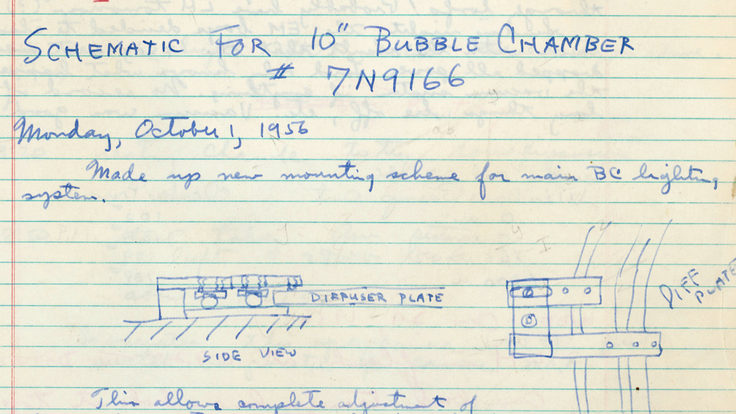
Luis Alvarez, a physicist at what today is the Lawrence Berkeley National Laboratory, attended a 1953 meeting of the American Physical Society and heard a young University of Michigan physicist named Donald Glaser describe a particle detector he’d developed and called a “bubble chambe
If this magnet could talk, you'd hear some amazing stories. During its half-century career, this four-million-pound magnet contributed to experiments that changed our view of physics while serving some of the field's foremost experimenters, including Enrico Fermi.
Security officers raise and lower 20 flags in front of Fermilab's Wilson Hall every day. Each flag represents a country that researchers come from to work at the lab. "The problem is that there are twenty flag poles," says Fermilab's Roy Rubinstein.