Science fair season is here, so we at symmetry were not surprised when 12-year-old Austin Ellsworth of Spring, Texas, called with a few questions about his science fair project.
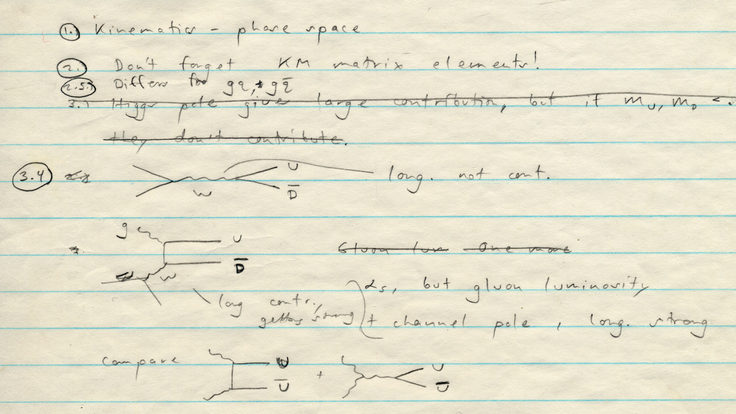
In 1985, ten years before scientists at Fermilab discovered the top quark, Scott Willenbrock was a graduate student at the University of Texas at Austin.
How do you renovate a delicate, irreplaceable detector? Very carefully. During the last four months of 2006, the BaBar collaboration at SLAC successfully replaced a prematurely aging muon identification system.
The Compact Muon Solenoid (CMS) detector is one of the two general purpose particle detectors being constructed at CERNs Large Hadron Collider (LHC) outside Geneva, Switzerland.
I have been attending hundreds of talks by particle physicists who look for a very specific experimental signature that is predicted by a very specific theory extending the Standard Model.
Guest houses are common among particle physics labs, and the Stanford Linear Accelerator Center is no exception. But in many ways, the Stanford Guest House, situated on the grounds of SLAC, is different.