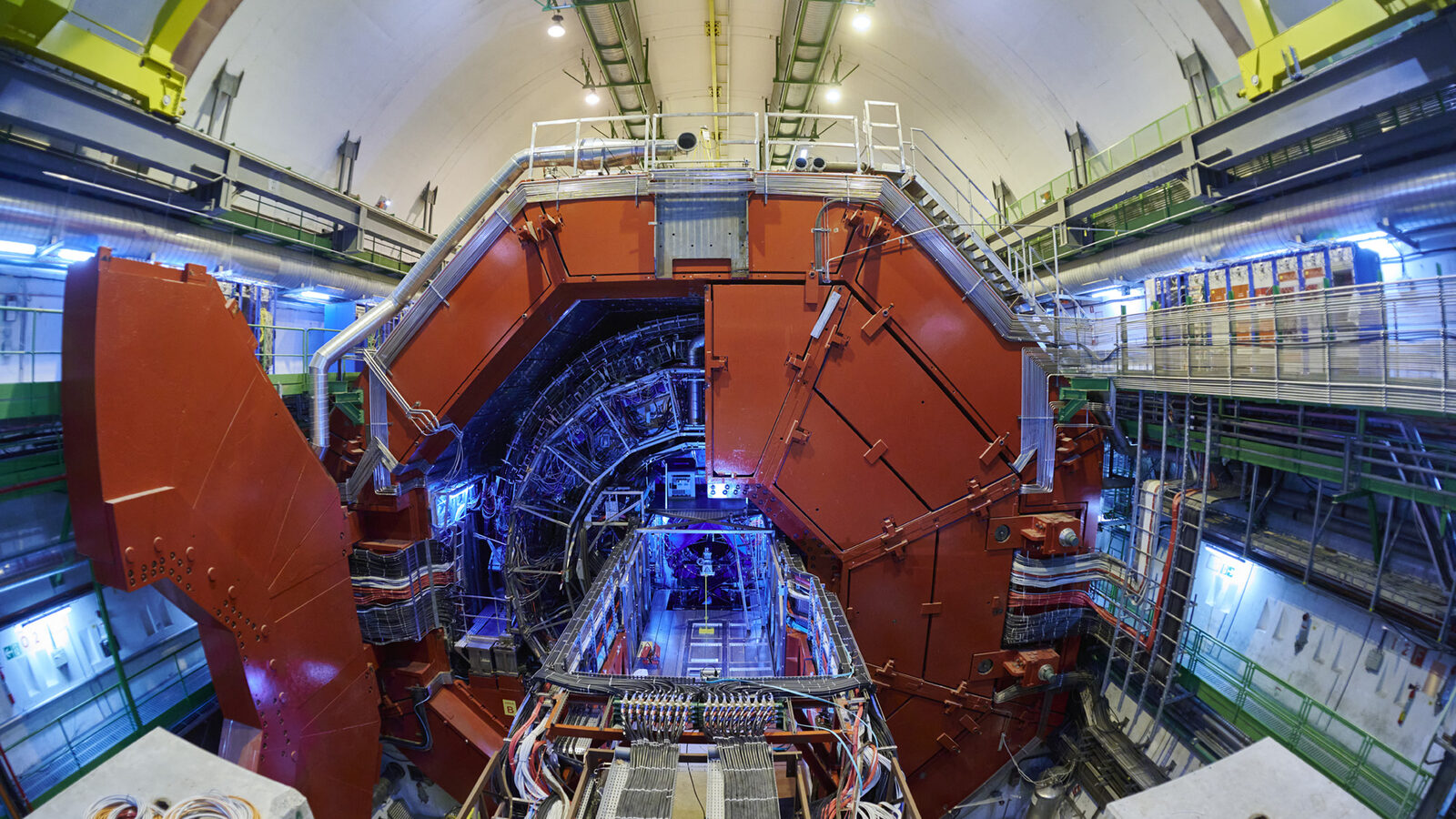
In 2023, the ALICE experiment was ready for their best year yet, until a mysterious signal threatened everything. As the LHC wraps up its 2025 lead-ion run, physicists recall how they worked together to solve the puzzle.
Canadian subatomic physics has a lot going for it: sparkling new hardware, an influx of bright young minds, and key roles in international projects. But only by doubling its operating budget can it live up to that potential, a new report suggests.
Sometimes even the language of mathematics isn't universal. This realization came during March at the German lab DESY where a party was thrown by the Asian ECal team in thanks for the use of the DESY Calorimeter Group's test beam.
University scientists are the backbone of particle physics; like cogs in a complex machine, they deliver expertise, funding, and equipment exactly where needed. At Vanderbilt, theyre developing ways to handle a flood of data from the Large Hadron Collider.
The Temple of Heaven, a masterpiece of architecture and landscape design in Beijing, symbolizes the relationship between Earth and heaven—human society and the universe—which stands at the heart of Chinese cosmology.
For million-dollar components that travel thousands of miles to become part of a particle detector, the most perilous part of the trip might be airport security.
Fermilab physicist Darren Crawford shares a birthdate, May 25, with the first Star Wars movie release. Now he is making his own mark on the fabled sci-fi fantasy series.
A snowstorm hit the Chicago area on February 13, before the start of the DOE/NSF agency review at Fermilab of the US ATLAS and US CMS collaborations, the US contributions to two of the Large Hadron Collider experiments.