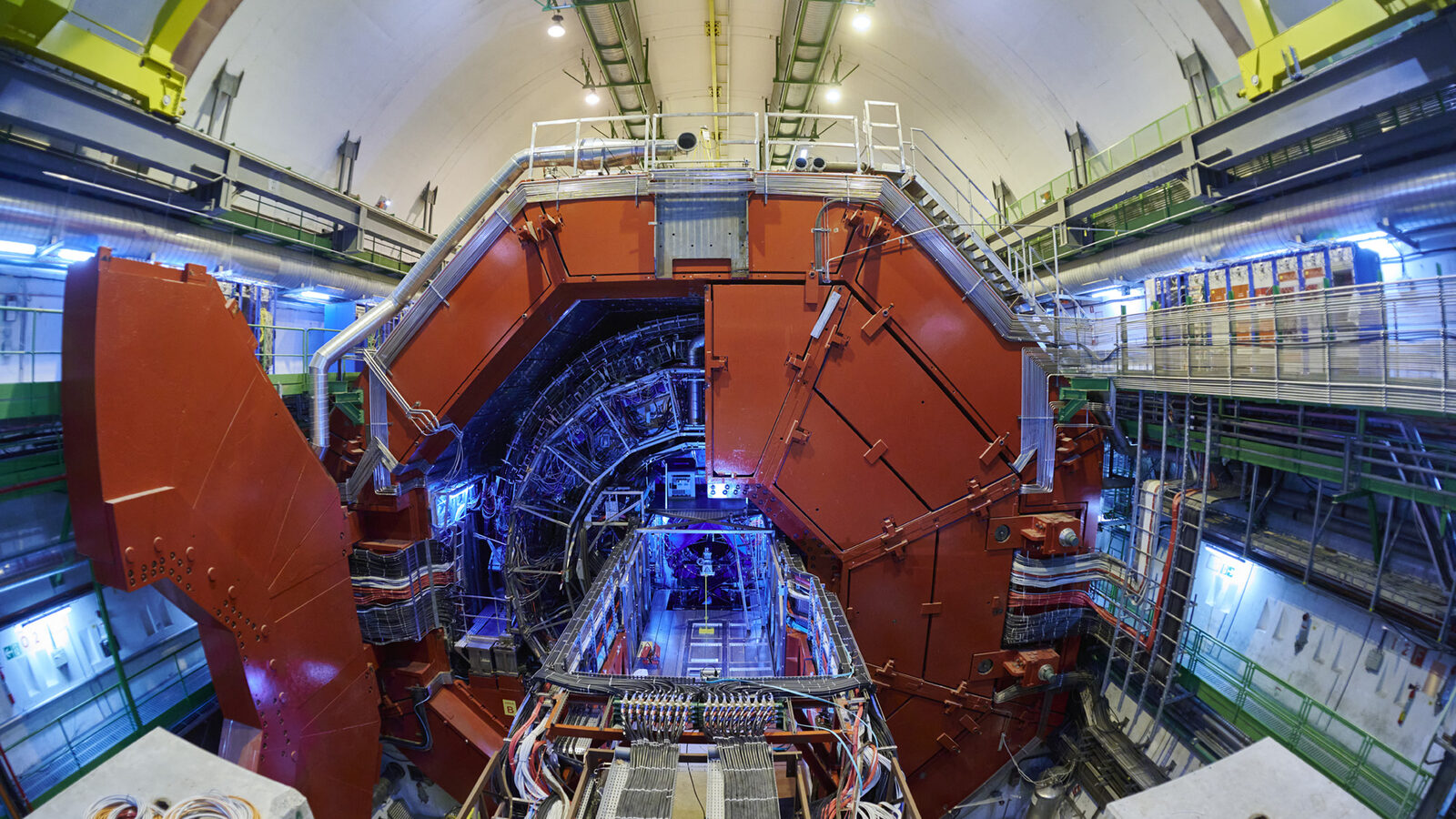
In 2023, the ALICE experiment was ready for their best year yet, until a mysterious signal threatened everything. As the LHC wraps up its 2025 lead-ion run, physicists recall how they worked together to solve the puzzle.
It began with a guest speaker in her small upstate New York town. Roshan Houshmand’s uncles were visiting, and because of their engineering background, she thought a talk on physics would be ideal for a night of entertainment.
Affectionately known at the Stanford Linear Accelerator Center (SLAC) as simply “The Blue Book,” The Stanford Two-Mile Accelerator has been a classic on site since the day it was published in 1968.
What is this stuff that fills the vacuum of space, accelerates the expansion of the universe, and accounts for 70 percent of everything? More than two dozen experiments aim to find out.
Even in the company of a two-story nose-picking machine, human cupcakes, battling robots, and power-tool drag races, the giant Tesla coil stands out. Maybe it's the loud buzz and crackle of artificial lightning bolts, writhing like fiery serpents from the top of the thing.
Inside, the auditorium at the National Museum of Natural History in Washington, DC, was packed and humming in anticipation. Outside, a man waved a sign at stragglers hurrying for the door: "Need One Ticket for String Theory Debate."
Mike Herlihy is active in the village of North Aurora, near Fermi National Accelerator Laboratory and west of Chicago. Hes been a village trustee for six years, belongs to the Lions Club and served on an advisory committee to evaluate a proposed freeway.
Lead bricks and radiation gloves normally indicate a need to protect lab workers from radioactivity. For a laboratory at the University of Alabama in Tuscaloosa, however, the opposite is true.