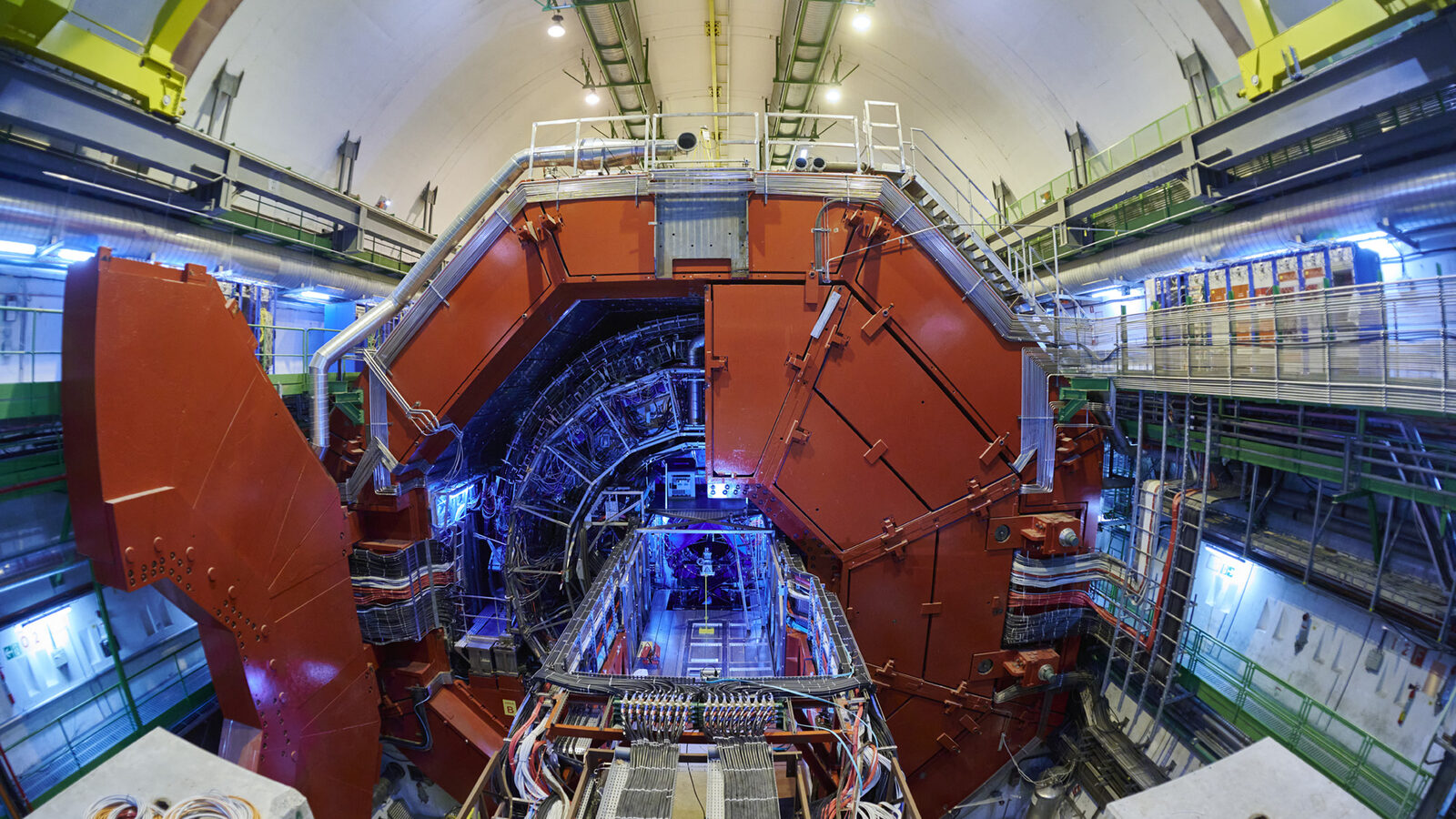
In 2023, the ALICE experiment was ready for their best year yet, until a mysterious signal threatened everything. As the LHC wraps up its 2025 lead-ion run, physicists recall how they worked together to solve the puzzle.
An overgrown zebra mussel population at Fermilab received a rude awaking when operations engineers treated the lab’s water cooling system in early June to remove nearly 4000 pounds of mussels.
Affectionately known at the Stanford Linear Accelerator Center (SLAC) as simply “The Blue Book,” The Stanford Two-Mile Accelerator has been a classic on site since the day it was published in 1968.
Lead bricks and radiation gloves normally indicate a need to protect lab workers from radioactivity. For a laboratory at the University of Alabama in Tuscaloosa, however, the opposite is true.
Just inside the site boundary, secluded from most of Fermilab, sits Leonard Baumann's rickety red barn. Baumann, like 55 other farmers, relocated 40 years ago to make way for the construction of Fermilab.
What is this stuff that fills the vacuum of space, accelerates the expansion of the universe, and accounts for 70 percent of everything? More than two dozen experiments aim to find out.
In the 1990s, astronomical observations revealed that the expansion of the universe is accelerating. Not knowing what causes this acceleration, scientists began to attribute the phenomenon to some unknown source of energy, coined "dark energy" by astrophysicist Michael Turner.
Inside, the auditorium at the National Museum of Natural History in Washington, DC, was packed and humming in anticipation. Outside, a man waved a sign at stragglers hurrying for the door: "Need One Ticket for String Theory Debate."
Mike Herlihy is active in the village of North Aurora, near Fermi National Accelerator Laboratory and west of Chicago. Hes been a village trustee for six years, belongs to the Lions Club and served on an advisory committee to evaluate a proposed freeway.