The Collider Detector at Fermilab (CDF) is one of two experiments that record the debris of powerful proton-antiproton collisions at the Tevatron particle collider to explore subatomic processes.
It was 80 degrees under a cloudless sky in St. Charles, Illinois. Thunder boomed. Lightning flashed, striking a kite and shooting down the string to a bald scarecrow. Its giant eyes glowed. “What’s that?” asked a Girl Scout working on a nearby display.
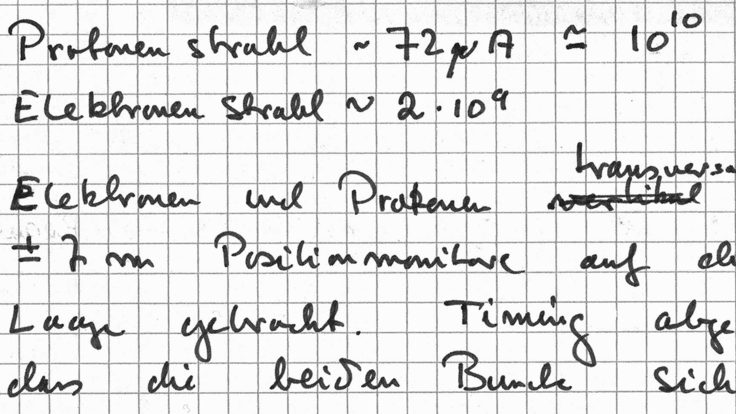
On October 19, 1991, at 6:50 p.m., Bjørn Wiik logged the first collisions in the new electron-proton particle collider at the Deutsches Elektronen-Synchrotron in Hamburg.
Men and women wearing gaudy dresses, looking for customers under garish neon signs—this is a common sight in Kabuki-cho, Shinjuku, a famous entertainment and red-light district in Tokyo, Japan.
Laughter punctuates the excited conversations, a mix of German and English. Drinks are passed around and children dart among the legs of the hundred or so scientists gathered together for one last time. The sky’s blue is deepening: only 90 minutes until sunset.
As technology evolves, posters are getting easier to produce and pass around. But it still takes skill and imagination to illustrate the abstract ideas of physics.
To artist and engineer Amy Lee Segami, water is no ordinary substance—it is her canvas. Using her knowledge of fluid mechanics, Segami paints on water in a contemporary version of the ancient Asian art form of Suminagashi.